Fiat 600 2026 review | Stylish SUV with just enough space for the family
Fiat 600 cars for sale
3.0
Expert review
Pros
Smart, fashion-conscious feel
Upmarket-looking interior
Competitive running costs
Cons
Not the roomiest
Engines can feel uncouth
Jiggly ride never really settles
The CarGurus verdict
If you really want a compact SUV that stands out from the crowd, the Fiat 600 isn’t a bad choice. For the price, there’s not much out there to touch its combination of style and space, and from inside, it feels good, too, as long as you don’t look too closely.
Just keep in mind there are better all-rounders out there: small SUVs that offer more space, lower running costs and better reliability, sometimes for a lower price. With that in mind, the 600 is a good buy only if its fashionable looks and cheeky character make it a must-have.

What is the Fiat 600 Hybrid?
It’s time to grow up. At least, that’s what the world keeps telling you: but you don’t really want to. Oh, sure, you might have a couple of kids in tow now, but that’s no reason to sell out and buy a dull, grey SUV.
Sound familiar? If so, the Fiat 600 has been designed with you in mind. The idea is simple: take the fashion-conscious styling and fun colour schemes that have made the smaller 500 so popular, and apply them to a crossover SUV that’s large enough to fit the kids in the back, but not so vast that it becomes unwieldy around town.
Fiat is hoping that strategy will help the 600 stand out in a crowded part of the market; it’ll have to fight off rivals like the Renault Captur, Ford Puma, Toyota Yaris Cross and Nissan Juke: not to mention competitors from within the Stellantis conglomerate of which Fiat is now a part, such as the Jeep Avenger, Vauxhall Mokka and Peugeot 2008.
Just like its Stellantis-built stablemates, the 600 is available with both petrol mild-hybrid powertrains, and in all-electric form. We've written a separate review for the EV version, and here, we're concentrating solely on the combustion-engined versions.

How practical is it?
The 600 might aim to be a more practical version of the 500, but that isn’t really a particularly high bar. It’s fine, really, but it won’t beat the best-in-class in terms of the amount of space you get inside.
The 385-litre boot is about average for the class, and while a variable-height load floor – a useful addition to have – is available, you don’t get it on the most basic model.
In the rear seats, meanwhile, space is adequate, if not exceptional. Adults sitting behind adults will squeeze in OK, but won’t love the shortage of knee room. And those belting kids into car seats may find that access is tight.
Up front, the news is better; there are some good-sized cubbies dotted about, and space for you and your front-seat passenger is fine. The only real downside here is the wireless phone charger, which is absolutely useless at holding your phone in place, so it rarely works properly. Don’t throw out that cable just yet.
Visibility is OK, although the thick pillars and small rear screen mean you’ll rely heavily on the parking sensors when you’re reversing.

What’s it like to drive?
There’s a choice of two petrol powertrains in the 600 Hybrid: and, yes, they do both get hybrid assistance. Don’t, however, be misled into believing these are full hybrids like the Toyota Yaris Cross and Renault Captur: the 48V powertrains fitted to the 600 feature less muscular electrical assistance, and as a result, they fall into the category of ‘mild’ hybrids.
That means the little 1.2-litre petrol engines are having to do most of the work, and boy, you can tell. It’s not that the 134bhp version we’re testing here feels slow (though we can’t speak for the 99bhp alternative): it’s more that when you do call for extra grunt, it’s served up with a generous side order of engine noise.
What’s more, you can feel a slight jolt when the electric motor gives way to the petrol engine at low speeds. In short, this isn’t a particularly finessed powertrain.
As we’ve said, though, it doesn’t feel too lethargic, particularly at town speeds, where there’s more than enough pep to be getting along with. Out on the motorway, it does feel a little less comfortable, occasionally running out of puff when you demand full acceleration on uphill sections. To be fair, however, that only happens very occasionally.
In these environs, you might be hoping that the slightly jittery, bumpy ride that the 600 exhibits at lower speeds is ironed out. Sadly, that isn’t the case, which means no matter where you are, the 600 feels somewhat unsettled, and not particularly relaxing. That engine noise doesn’t help.
The suspension’s stiffness pays off on a twisty road, mind you: clearly, Fiat has set this car up to feel engaging when it’s chucked about a bit, and so it does, relishing direction changes with an alertness you just don’t get in, say, a Renault Captur.
Sadly, the steering is too light and over-assisted, so you don’t get very much feel. That makes you feel somewhat disconnected from proceedings, and means the 600 isn’t quite as much fun as it could be.

Technology, equipment & infotainment
Inside the 600, there’s an odd mix of stylish, upmarket-feeling touches, and scratchy plastics. This may be a conscious choice from Fiat, because the former ensure you don’t notice the latter too much.
Take that big ovoid slab of body-coloured (or champagne gold, in the La Prima) plastic that spans the width of the dashboard. It lifts the interior well enough that it completely distracts you from the hard black plastic that surrounds it.
The same goes for the door panels. Soft faux-leather upholstery around the armrests and door grabs takes your mind off the brittle, rough-feeling plastic above and below, not to mention the rather cheap-feeling door handles.
In front of the driver sits a natty circular instrument binnacle, deep within which you’ll find the digital screen that bears the speedo and other driving information. There’s a lot to fit in this relatively small space, though, and it can feel a little busy and cluttered at times.
But elsewhere, the 600’s cabin is better geared toward usability. The gear selector – four push-buttons – is simplicity itself to use, while the row of piano-key switches above it gives you easy access to the main climate controls.
You do still have to go into the touchscreen to find and operate certain functions, and that’s a problem given it can be rather laggy. Take the heated seats, for example: on a cold morning, you’ll wait what seems an age for the touchscreen to come to life so that you can delve into the climate control menu to activate them.
This is a shame, because the touchscreen’s menus are actually quite well laid out, but that glitchiness does add a layer of distraction whenever you want to find your way through them. That’s because you’re never quite sure whether your attempt to prod a certain on-screen icon has been registered or not.

Fiat 600 running costs
Pricing for the 600 is about average for the class. Some rivals, like the Ford Puma, cost more, while others like the Dacia Duster, give you more for your money. That said, when you take into account the 600’s fashion-forward bent, it seems like pretty decent value: style doesn’t come for free, after all.
The official average fuel economy rating of 59mpg for the 99bhp model is pretty good, and beats similar petrol-powered models: in the real world, that should equate to an average of around 45-50mpg. Even better, the more powerful 134bhp variant has an identical fuel economy figure, so there should be no penalty for the extra power. In fact, returns might even be better in the real world because the more powerful unit likely won’t have to work as hard for equivalent performance.
That said, do bear in mind that the 600 is a mild hybrid, and as a result, it isn’t quite as efficient as its most economical full-hybrid rivals. A Renault Captur E-Tech, for example, will get five or six miles per gallon more, and it’s no more costly to buy, like for like.
No 600 has a basic list price that’s anywhere near the £40,000 premium car tax threshold, so even if you specify all the options on the list – which basically amount to just exterior paint colour and that contrasting roof - that shouldn’t be a concern. In other words, no matter what you do, you should be paying no more than the basic rate, currently charged at £195 per year.
Servicing is carried out every year or 12,000 miles, which means if you do a higher mileage, the 600 may end up costing you slightly less in maintenance over time than a rival with a 10,000-mile service interval.

Fiat 600 reliability
The 600 is still relatively new, so we aren’t aware of any serious or common issues you need to look out for just yet. That said, the model finished a fairly unexceptional 24th out of the 38 small SUVS to be included in the latest What Car? Reliability Survey. Fiat’s performance as a whole was even more underwhelming, with a 28th-place finish out of the 30 manufacturers to have taken part.
Those reliability concerns won’t be assuaged by the warranty that’s on offer, either. Fiat gives you a three-year, 60,000-mile guarantee, which is about the bare minimum you can expect on the UK market these days. What’s more, there are quite a few rivals out there that will keep you in warranty for longer, much longer in some cases.
- If you’ve got off-road parking, it might be worth considering the electric version of the 600 instead. With a charging point and an EV-friendly home power tariff, running costs on the 600e will be much lower, and you get exactly the same retro styling both inside and out.
- The 600 isn’t just a blown-up version of the 500; it’s actually a homage to the original Fiat 600, which itself was a larger, more family-friendly version of the original Fiat 500. It was a bit more unconventional than today’s 600, though, with rear-hinged suicide doors, an air-cooled engine mounted in the back of the car, and a boot under the bonnet. Things got even more crazy with the 600 Multipla, a dinky mini MPV that could be had with as many as six seats.
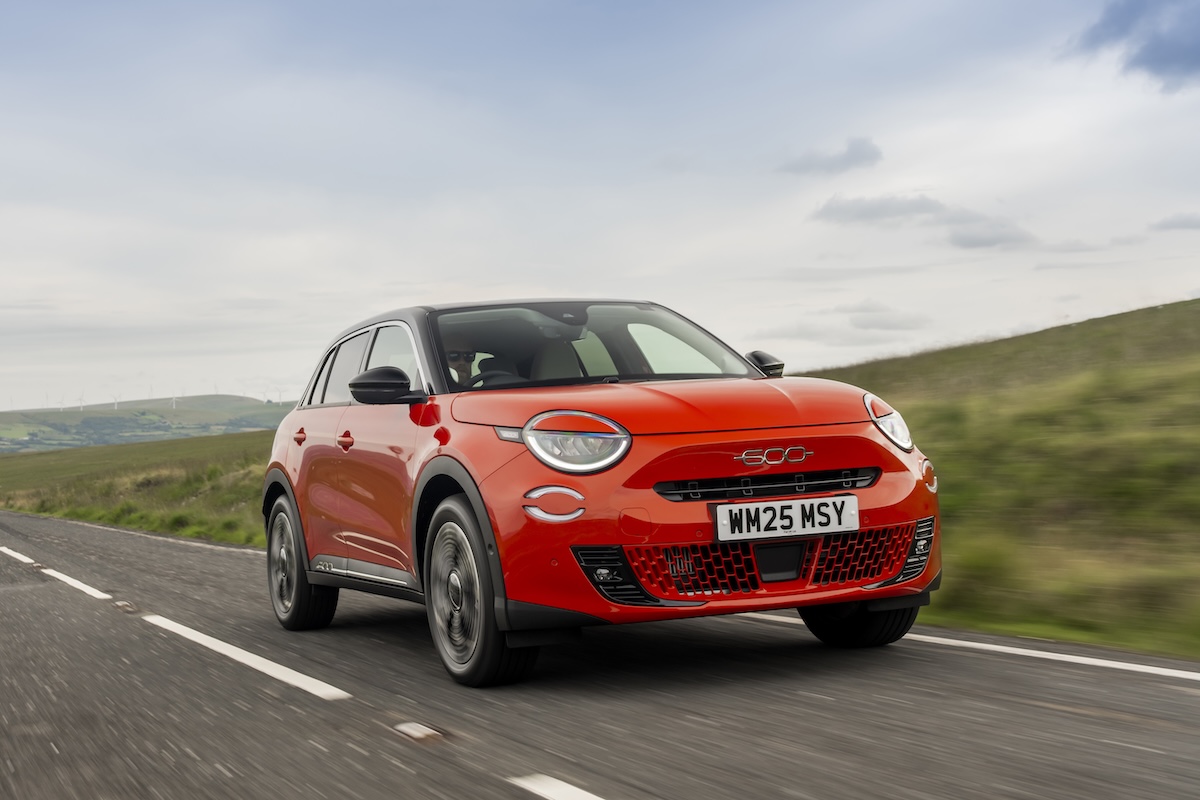
- Personalising your 600 is pretty good fun thanks to a rather funky range of colour schemes, with a black contrast roof available as an option on all of them. If you’re going for the LaPrima, however, just keep in mind that the turquoise stitching on the seats comes as standard, so choose your exterior colour carefully if you want to avoid a clash. Our test car came in orange, with the contrast roof, and the overall effect was somewhat busy.
- If you’re on a budget: go for the basic 600 Hybrid. This version doesn’t have a name, and it doesn’t have all that much kit, either, but it does still feel stylish, with that body-colour dashboard, ‘FIAT’ logo upholstery on the cloth seats, and almost identical exterior styling to the posher models. Crucially, choosing the 99bhp engine means you’ll get this car for a very reasonable price.
- If you want all the toys for the least cost: Go for the 99bhp engine with LaPrima trim. It won’t be very fast, but you’ll get all the equipment you want, and the added bonus is that running costs will be low thanks to this engine’s frugal nature.
- If you want the best all-rounder: Normally we’d recommend the mid-range trim here, but in fact, as the top-spec La Prima isn’t that much more expensive – and you get so much more equipment thrown in – we’d say it makes sense to upgrade. Throw in the 134bhp engine, and you’ll have the best 600 Hybrid of all.
- If you want a softer ride: Having said that, the LaPrima does come with 18-inch wheels, which might well contribute to that slightly skittish ride quality. Dropping to Icon trim tones the wheel size down to 17 inches, which should make the 600 feel more pliant.

