Omoda 5 2026 review | A keenly priced crossover from China
Omoda 5 cars for sale
2.0
Expert review
Pros
Very aggressive purchase prices
Generous luxury equipment
Not bad on cabin quality
Cons
Petrol powertrain feels half-finished
Sub-par on ride and handling
Not as practical as rivals

The CarGurus verdict
You might well clap eyes on the Omoda 5 and be tempted by its impactful and cohesive good looks. Then on further inspection, you may well be tempted further by its convincing cabin quality, its very keen pricing and its heaving list of standard luxury equipment. On the face of it, then, you’d think this new compact SUV from China has what it takes to worry more established rivals from Europe, Japan and Korea.
Before you sign on the dotted line, however, we’d urge you to delve a little deeper. In the petrol form we’ve tried, the Omoda 5 has some fairly fundamental dynamic shortcomings, both with its powertrain – which also isn’t very efficient – and with its ride and handling balance. We also have some quibbles with its infotainment system, and although its practicality is okay, many rivals are considerably better on that score.
The electric E5 and newer SHS-H hybrid versions may address some of those weaknesses, and the Omoda 5’s price, warranty and standard equipment are undeniably appealing. Don’t dismiss it out of hand, perhaps, but go in with your eyes open.

What is the Omoda 5?
Before we explain what the Omoda 5 is, you might need us to explain what Omoda is first. Omoda is a brand that was launched in the UK in late 2024, closely followed by its sister brand, Jaecoo, in early 2025. Both form part of Chery, a large Chinese car manufacturer that is big business in its home market and one of China’s major exporters of new cars. Chery uses various different brand names in different parts of the world, and Omoda and Jaecoo were those chosen to lead its charge in the UK and Europe. They've since been followed in Chery's portfolio by a more budget-focused brand, known - somewhat confusingly - as Chery, and a premium brand in the form of Lepas.
The Omoda 5 itself is a mid-size family SUV that’s pretty much the same size as one of the UK’s best-selling cars: the Nissan Qashqai. Coincidence? We think not. It catches the eye with its impactful angular styling, while the heavily sloped coupe-like roof is reminiscent of the one found on the Peugeot 3008.
At launch, the Omoda 5 was offered in petrol and electric forms, the latter badged E5, but the range has since grown to include the Omoda 5 SHS-H self-charging hybrid as well. That gives buyers a choice of petrol, hybrid or electric power, depending on their budget and how they plan to use the car.
The Omoda 5 tries to tempt buyers away from more recognisable rivals with not only its styling, but also low prices and generous equipment. Don’t go thinking that this is some cheap Chinese knock-off, though, because the quality on display all around the car is actually pretty impressive. As we’ll find out during this review, though, there are other sacrifices to make for Omoda’s apparent generosity…

How practical is it?
The Omoda 5 is just about practical enough, but without getting close to troubling the best-in-class in this area. There’s no shortage of space in the front seats, but things feel rather tighter in the rear. Legroom is acceptable, although appreciably more limited than you get in a Nissan Qashqai, while the car’s sloping roofline also eats into the rear headroom. Passengers up to six feet tall will just about be okay, but anyone taller than that is going to struggle, so gangly teenagers might not thank you for choosing the 5. The cabin is a bit narrow to comfortably seat three across the rear bench, so it’s best to think of this car as a four-seater that can occasionally accommodate a fifth person for short trips. That's not a huge criticism, though, because the same applies to many cars in the class.
The boot is rather underwhelming, though. At 380 litres, it’s about the same size as what you get in a family hatchback such as the Volkswagen Golf. By the standards of other mid-size SUVs, it’s quite small. The space is also rather shallow, too, but at least there isn’t too much intrusion from the rear wheelarches.
There’s a false floor that levels off a small load lip, and when you drop the 60:40-split rear seats to free up more cargo space, that same false floor levels off a small step up to the folded seatbacks. The seats lie flat, too, leaving you with an extended load area that is level and stepless.
When it first went on sale, one of the slightly strange things about the Omoda 5 was that the interior differed according to the powertrain you chose. In the petrol-powered car, you’d find touch-sensitive air-con controls on the central dashboard panel, and a centre console that features both a stick-type gear selector and a large wireless smartphone charging pad. In the electric version, meanwhile, the gear selector lever was moved to the steering column, while the air-con controls disappear, leaving you to operate that system – along with many others, which we’ll come on to in more detail in a moment – through the touchscreen. You’d also notice different designs and integrations for things like the air vents and window switches, and the electric version also features some glossier panels and reasonably convincing wood-effect trims.
From a usability perspective, the petrol car was actually better because there was more physical switchgear, meaning you weren't not so reliant on the touchscreen. However, since the car was launched, the interior treatment from the electric version has been made standard across all versions of the Omoda 5 - petrol, hybrid and EV - and as such, you'll be tapping away on a touchscreen more than you might like.
The quality feels convincing, though: although pretty much every surface you encounter is made of plastic, most of it feels reasonably posh in the way it’s textured and finished. Only a few panels in the lower reaches of the cabin let the side down. The quality of the materials in the electric version is of a more uniformly high standard, and along with the glitzier trim pieces on show, this makes for a slightly posher feel.
All versions of the 5 come with electric adjustment for the driver’s seat, and a very decent range of manual movement in the steering column, so finding a comfy driving position is fairly easy. However, a tiny rear window with chunky pillars either side means your rearward visibility is rather hampered.

What’s it like to drive?
The Omoda 5 is now available in petrol, self-charging-hybrid and electric formats. The electric version, badged E5, has a 150kW electric motor powering the front wheels and can cover up to 267 miles on a single charge, according to official figures.
We’ve driven the older petrol-engined version, which had a 1.6-litre turbocharged four-cylinder engine developing 183bhp and mated to a seven-speed twin-clutch automatic transmission. That version hit 62mph in 7.8 seconds and had a top speed of 128mph. The current petrol model is less powerful, with the 1.6-litre turbocharged engine producing 147bhp. This sees its 0-62mph time increase to 10.1 seconds and the top speed drop to 121mph.
The power and pace on offer looked fine on paper in the earlier petrol car, but in reality, the way it was delivered was problematic at best, and ruinous at worst. The issue centred around a throttle pedal that was both hugely oversensitive and woefully inconsistent in the way it operated. The result was that any minuscule variation in the position of the pedal had a massive effect on how the powertrain reacted, and it was pretty much impossible to predict what that reaction would be, so driving the car smoothly was exceptionally difficult.
Here’s a for-instance. When you first pulled away, you’d press the accelerator down what you thought was a reasonable amount, and the response from the engine would be lacklustre to the point of feeling like you were desperately short of go. And then the next time you pulled away from the mark, you’d press the pedal what you believed to be an identical amount to the first time, but this time, the engine revs would be sent sky-high, and you’d find the car lurching forwards way more quickly than you intended, sometimes to the point where the front wheels were spinning up as they scrabbled for traction. And no matter how careful you were with your throttle inputs, the pedal was still all-but-impossible to modulate smoothly.
There was more. If you’d been stationary long enough that the stop-start system had cut the engine, then this whole process was prolonged annoyingly. Press the go pedal and you had to wait for a couple of seconds for the engine to fire up, the transmission to engage drive, and the wheels to start turning. And even after all that, you still had zero idea about precisely how much off-the-line pace your throttle input was going to get you.
Pick up speed on the move rather than off the line, and the throttle became slightly easier to modulate, so it was possible to achieve at least some modicum of smoothness. But even then, the way the powertrain reacted could still take you by surprise occasionally, and the responses of the throttle and gearbox were always annoyingly slow.
The Omoda 5’s petrol powertrain lacked plenty of polish, then, and unfortunately, so did the suspension, albeit to a lesser extent. It has quite a soft setup, but despite that, there’s an underlying tremor to be felt for too much of the time, particularly over scruffy urban road surfaces. Tackle a bigger bump or a pothole, meanwhile, and you feel more of a jolt through the suspension, which is then followed by a period where the car’s body bobs up and down for slightly too long. The ride gets a lot better at motorway speeds, where the suspension does a decent job of smothering bumps without too much vertical bounce.
The handling isn’t exactly game-changing, either. There’s a bit of body-roll to be felt as you change direction, although this is totally forgivable in a family SUV, and you won’t be rolling around to the extent where anyone is going to start feeling queasy. More problematic is the rubbery, artificial feel of the steering, which makes it feel less accurate than it might be, and the car generally feels bigger and heavier than it is. That’s the case both when changing direction and when you’re hard on the brakes, and it all adds an extra layer of untidiness to the way the 5 moves down the road.
The tone for the car's level of refinement is unfortunately set by the jerkiness and unpredictability of the powertrain, and the coarse scream made by the petrol engine when the revs are sent sky high on an all-too-regular basis. Aside from that, however, it’s actually not too bad. The engine quietens down nicely once you settle into a steady motorway cruise, and wind noise and road noise are both pretty well suppressed, too.
The latest addition to the range is the Omoda 5 SHS-H self-charging hybrid, which combines a 1.5-litre turbocharged petrol engine with electric assistance. With a 0-62mph time of 7.9 seconds and potential combined range of 650+ miles, it has the potential to be the most interesting model in the range.
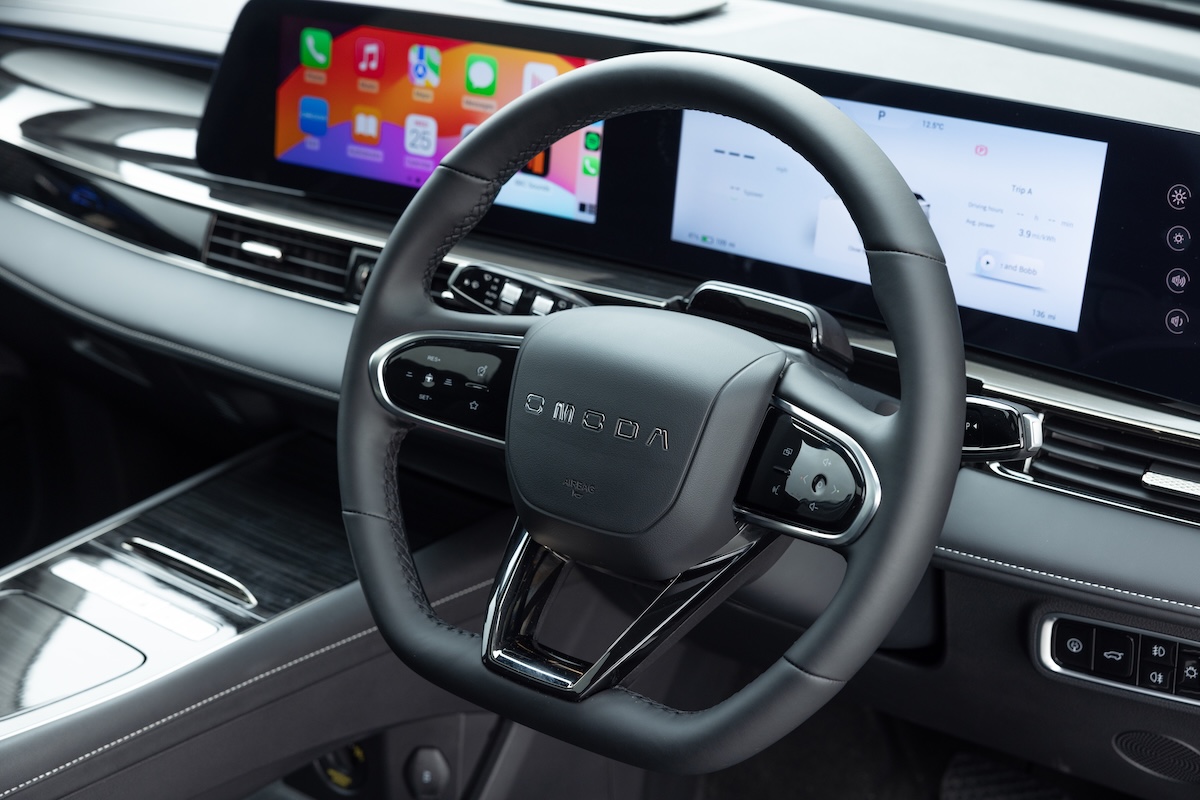
Technology, equipment and infotainment
The Omoda 5 is offered with different trim names depending on whether you choose petrol, hybrid or electric power, but whichever version you look at, standard equipment is generous for the money. Petrol and hybrid versions are currently offered in Knight and Noble trims, while the E5 electric comes in Comfort and Noble forms.
Even the cheaper versions come with plenty of kit, including alloy wheels, a pair of 12.3-inch displays, keyless entry and go, adaptive cruise control, parking assistance, wireless smartphone connectivity and a suite of driver assistance systems. Higher-spec models add the likes of an electric sunroof, dual-zone climate control, electric seat adjustment, an air purification system and an electric tailgate.
Current Omoda 5 models use twin digital displays, with a 12.3-inch digital instrument cluster and a 12.3-inch central touchscreen. It’s an impressive setup for not much money, and it helps the cabin feel suitably modern.
Functionality is strong, with wireless smartphone mirroring, wireless phone charging and plenty of connected features available depending on version. The problem is that the system’s ease-of-use is rather less convincing. Several crucial and frequently used functions are buried too deeply within the menu structure, meaning even simple tasks can require too many taps and swipes. That’s time your attention is diverted away from the road.
You could try using the car’s voice control to perform such tasks instead, but during our time with the car, there wasn’t a single occasion where we issued a command that it both understood and carried out. Not one.

Omoda 5 running costs
The Omoda 5’s purchase costs will be key to its appeal for most buyers. Prices start at around £24,000 for the petrol version in Knight trim, rising by £3,500 if you want the higher-spec Noble version. For context, the cheapest version of the Nissan Qashqai, which has considerably less power and kit, starts at more than £30,000. The Omoda 5 SHS-H hybrid also looks temptingly priced, starting at under £26,000, while the all-electric E5 starts at around £33,000. By comparison, the very cheapest version of the Peugeot e-3008 starts at more than £36,000.
Go for the petrol version, though, and your fuel costs won’t be nearly so appealing as the purchase price. In a world where every petrol car claims to be a hybrid of some sort, there’s no 48-volt tech or electric assistance for the old-school powertrain in the Omoda 5, and as a result, the WLTP combined fuel economy figure stands at just 31.1mpg. That looks poor in isolation, and even poorer when you consider that the entry-level Qashqai returns figures in the mid-forties.
The SHS-H hybrid should help here, because Omoda claims a fuel economy figure of 52.2mpg and a potential range of more than 650 miles. We haven’t driven it yet, so we’ll reserve judgement until we know how it performs in the real world, but on paper it looks like the version that makes most sense from a running-cost perspective if you don’t want to go fully electric.
The fully electric E5 has the potential to be much cheaper to run, provided you can charge at home. Its 61kWh battery gives an official range of up to 267 miles, which is decent rather than class-leading. A full charge at home should still cost far less than a tank of petrol, especially if you’re on an EV-friendly overnight tariff, but real-world range is likely to be lower than the official figure, and it will fall more quickly on long motorway slogs and during the winter months.
A full charge from a typical 7kW home wallbox is likely to take around 10 hours, while using a regular domestic three-pin socket is best kept for occasional top-ups rather than full charges. If you’re in more of a hurry, then DC rapid charging is supported, but the maximum charging rate is modest by modern EV standards. Omoda quotes a figure of 28 minutes to charge from 30-80 percent, which doesn’t sound dreadful, but that only accounts for half the battery’s capacity. Many rivals will charge from 10-80 percent in that kind of time.

Omoda 5 reliability
It’s always difficult to predict the reliability of a new car, and you’re usually left looking to the manufacturer’s past reputation and performance in the area for clues. However, that’s tricky where Omoda is concerned, because while the brand is no longer quite as fresh to the UK as it was when the 5 first arrived, it still hasn’t been here long enough to build up a meaningful long-term reliability record. As a result, the mechanical dependability of both the brand and this car remains something of an unknown.
You might well take confidence from the warranty provided with the Omoda 5, though. Like the much-lauded Kia warranty, you get seven years or 100,000 miles of cover – whichever elapses first – while the high-voltage battery warranty on electrified versions runs for eight years or 100,000 miles. This length of cover is generous by class standards, and it should help soothe some of the nerves that naturally come with buying from a relatively new brand. Omoda Roadside Assistance is also provided, giving extra reassurance if something does go wrong.
Initially, this warranty was not everything it seemed, however. Many warranty arrangements have certain exclusions where the cover on certain parts ends before the cover on the rest of the car, but the list of exclusions in Omoda's case was a lot longer than normal, many of the parts in question were items that cost a lot to replace, and the cover you actually got on those items was alarmingly short. For instance, you only three-year-40,000-mile cover on the brake calipers, timing belt, water pump, oil pump, fuel pump, fuel injectors, alternator, starter motor, air-con compressor, catalytic converter, the entire exhaust system, the infotainment unit and several suspension components.
To be fair to Omoda, however, the brand took steps in mid-2026 to rectify this situation, and the cover on the vast majority of those items now runs for the full seven-year-100,000-mile period as advertised. What's more, the upgraded cover is also applied to cars bought before the upgrade occurred, meaning that pre-existing owners also benefit. That's to be commended.
- The Omoda 5 comes with the same extensive suite of safety equipment regardless of which trim level you choose, and that’s to be applauded. The preventative driver aids you get include autonomous emergency braking, adaptive cruise control, blind-spot monitoring, lane departure warning and prevention, rear cross-traffic alert, speed limit recognition and a driver attention monitor. And if that little lot isn’t enough to prevent you getting into trouble, there’s a comprehensive set of airbags to help keep you safe in a smash.
- For the most part, these preventative driver aids aren’t too overbearing in the way they operate. In a lot of cars these days, you’re subjected to a constant barrage of bongs and beeps if the systems think you’re not doing what you should, but we found this largely wasn’t the case with the Omoda 5. The one exception to that is the driver attention monitor, which seems to take great joy in regularly telling you off for becoming distracted, which is especially annoying when it’s usually the car’s own overcomplicated touchscreen that has caused you to divert your eyes away from the road ahead.
- The petrol-powered version of the Omoda 5 was crash-tested by Euro NCAP back in 2022, two full years before it went on sale in the UK. It achieved the full five stars, but since the tests get harder and harder every year, there’s no guarantee that a five-star car of 2022 would still be a five-star car now. However, the news looks rather better when you consider that the electric Omoda E5 also achieved a five-star Euro NCAP rating in 2024.
- If you want the most affordable version: The entry-level petrol version of the Omoda 5 is very temptingly priced, and still comes with a very generous amount of standard equipment. You will, however, have to put up with modest performance, steep fuel consumption and an unpolished-feeling drivetrain.
- If you want the version that’s cheapest to run: It’ll cost you a lot more in the first place, but the all-electric E5 version could save you a packet in running costs if you can charge at home. Just make sure you can live with the 267 miles of range, which is decent rather than outstanding compared with many EVs.
- If you want the most convincing Omoda 5: The SHS-H hybrid could be the one to go for. We haven’t driven it yet, so we’ll reserve judgement for now, but on paper it looks like a better fit than the petrol version, promising stronger performance and much better fuel economy without requiring you to plug in.
- If you want the more popular petrol alternative: The Nissan Qashqai is all-but-identical in size to the Omoda 5, and if we’re honest, does most things better, being more practical and more polished to drive. It’s pricier, of course, but there’s a reason it’s one of the UK’s best-selling cars.
- If you want a more mainstream electric alternative: The Peugeot e-3008 has a similar bold, angular design to the Omoda 5, and a similarly slopey coupe-like roofline, and so the level of on-road presence is also pretty similar. You’ll likely be more dazzled by the Peugeot’s gorgeous interior, though.