Peugeot 3008 Review (2024-present)
Peugeot 3008 SUV cars for sale
3.0
Expert review
Pros
Smart looks
Really nice interior
Good infotainment system
Cons
Mild hybrid powertrain isn’t great
A bit average on the road
Some ergonomic frustrations

The CarGurus verdict
There are many areas in which the Peugeot 3008 impresses greatly. The styling is fabulous inside and out, and the interior quality immediately makes you want one. Practicality is pretty good despite the car’s sloping rear roofline, and there’s a huge amount of standard kit provided, including a flashy infotainment system.
There are some disappointments, though. In the form we’ve tried it, it’s distinctly average on the road, with a knobbly ride, so-so handling and a ponderous powertrain that can get rather noisy. The driving position might also feel slightly awkward for some, and there are a few other ergonomic irritations, too. Overall it’s a solid all-rounder, and many will forgive its foibles for those looks and that interior.

What is the Peugeot 3008?
It probably seems strange to say it, but the Peugeot 3008 is a bit like Madonna: it’s a stalwart of its industry that’s striven to reinvent itself a number of times over the years in order to stay relevant.
When the first iteration was released in 2009, it was a car that didn’t really know what it wanted to be. It was part hatchback, part MPV, part off-roader (styling-wise, that is, there was never a four-wheel-drive option), and the result was a rather curious-looking contraption that was, despite its oddball looks, actually pretty good as a family car. By the time the second-generation car came along in 2016, the trend for crossover SUVs had properly taken hold, and the 3008 jumped firmly on that bandwagon, becoming much more coherent and stylish as a result.
Now that this third-generation version has landed, the 3008 has evolved again. It’s still an SUV like the Mk2, but this time it’s one of those style-focused coupe-SUVs, with a dramatically-sloping roofline towards the rear of the car for an extra dose of eye-catching visual drama. And it’s a very handsome car as a result, helped further by its bold details and angular lines.
Despite the changes, though, the core appeal of the new Peugeot 3008 is pretty much the same as before. It provides the stand-out style that family car buyers want along with the practicality they need, and it has a wonderfully stylish and high-quality interior that gives instant want-one factor. It comes stuffed with standard kit whichever of the two trim levels - Allure and GT - you choose, and it’s offered with a choice of hybrid powertrains. That, it would seem, prepares the car well to compete with popular family SUV rivals such as the Nissan Qashqai, Volkswagen Tiguan, Renault Rafale, Seat Ateca, Skoda Karoq, Kia Sportage and Hyundai Tucson. Given its style and quality, you might also consider it alongside premium alternatives such as the Audi Q3 and BMW X1.
Note, if you'd prefer an electric version, check out our separate review of the Peugeot e-3008, which is a rival to cars such as the Tesla Model Y and Toyota bZ4X.

How practical is it?
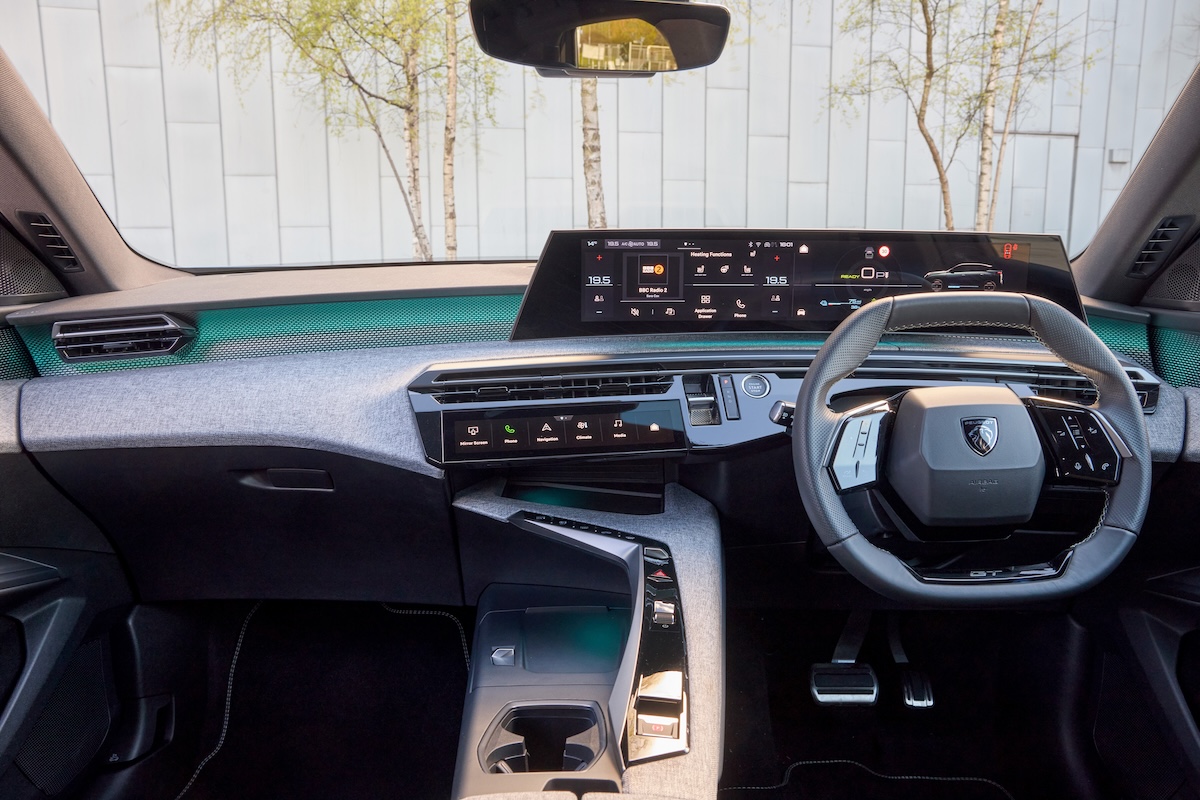
One of the biggest attractions about the previous iteration of the Peugeot 3008 was its stonkingly attractive interior, and even by such high standards, the new car really kicks things up a notch in this regard. The tone is set by the huge glossy-looking infotainment system (more on that in a while), while below that, the dashboard and central partition are festooned with a hugely varied collection of different materials, textures, colours and shapes. Rather than looking too busy, it’s executed elegantly and tastefully, making the 3008’s cabin look interesting, modern and stylish. You can find one or two hard plastic surfaces if you really hunt around in the lower reaches of the cabin, but these are nowhere near your eyeline or your fingertips, and everything that your senses do come into contact with looks and feels reassuringly expensive.
Another thing that contributes to the interior’s stylishness is the multicoloured ambient lighting. In the Allure-trimmed car, this emanates from beneath the infotainment display and centre console. The effect is far more pronounced in the GT version, though, because you get an extended ambient lighting package that sends light running along the alcove-shaped recess that runs horizontally across the dashboard and doortops. It looks really cool.
Of course, being a Peugeot, the 3008 has the French firm’s trademark i-Cockpit driving position. So, rather than looking at your driving instruments through your steering wheel like you do in most cars, you get a small steering wheel and you look at your instruments over the top of it instead. With some past Peugeot models, this has sometimes resulted in some drivers not being able to get comfortable: in order to see what they needed to see, they had to set their steering wheel too low for comfort, and some taller drivers would struggle to fit their knees under the wheel at all. With the latest 3008, though, there’s enough space around the various key elements of the driving position, plus enough manual adjustment for the driver’s seat and steering column, that comfort shouldn’t be an issue for most.
The seating position might still feel a little strange to some, but it’s nothing you won’t get used to. In fact, what might irritate you more is the shape of the steering wheel, because it’s not round: it’s more like some wonky octagon, the points of which get in your way when feeding the wheel from lock to lock.
Predictably, there’s loads of space in the front of the car, and the better news is that, despite that sloping coupe-like roofline, there’s plenty in the back, too. Headroom is sufficient for tall adults, while legroom in the rear seats is positively generous. Three people will squeeze across the rear bench for short hops, and life is made comfier for whoever sits in the middle thanks to a wide middle seat with an almost flat floor in front of it. That said, the cabin is too narrow to allow three to travel back there for long stints, which in fairness, is the same for most cars in the class. Overall, it’s not the roomiest car in the class, but it’s more than adequate.
Peugeot quotes the 3008’s boot capacity at 588 litres capacity, which is quite an impressive number. However, these numbers can be skewed quite a lot by variations in the way these things are measured by different manufacturers, and to us, the boot space looks to be quite a bit smaller than the number suggests. Importantly, it’s big enough to handle most of what a family will throw at it, but it’s no class-leader.
For maximum capacity with all the seats in place, you have to drop the two-level boot floor to its lower setting, although doing so leaves you with a boot lip of a couple of inches. Reinstating the floor to its higher setting turns part of your available space into underfloor storage, and it also levels off that boot lip. It also levels off the step up to the folded rear seatbacks when you drop those for maximum cargo-carrying capacity. The rear seats drop in a versatile 40/20/40 split, but the backrests lie at an angle, meaning there’s a gentle slope in your extended load area.
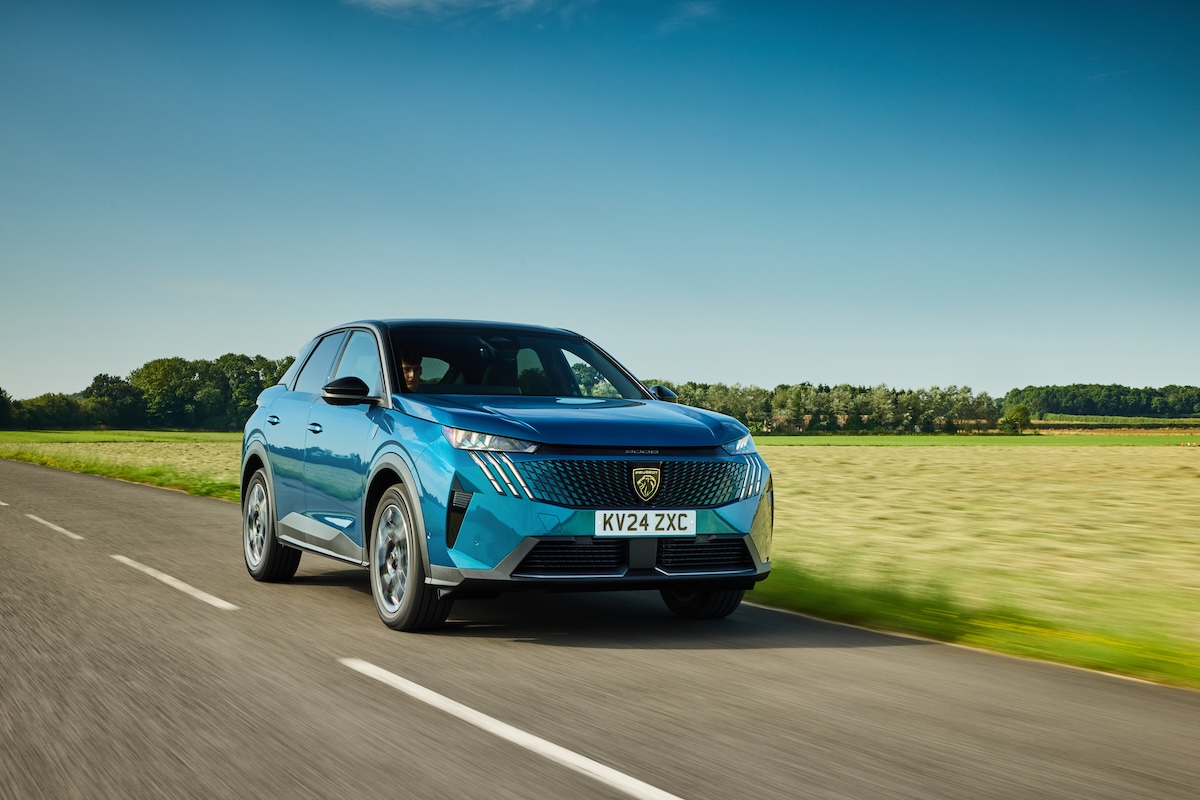
What’s it like to drive?
The previous second-generation version of the Peugeot 3008 was a really good car to drive, with strong body control, sharp responses and a generally light and pointy feel. Granted, the ride was a little on the firm side, but it was forgiving enough to keep a family comfortable. The latest third-generation car, then, has quite a lot to live up to.
And somewhat disappointingly, it doesn’t. Don’t get us wrong, it’s far from terrible, but some of the dynamic sparkle has definitely been lost. That firm ride has become a little firmer, so the effects of a scruffy road surface feel a little more severe for those inside the cabin. It’s certainly true that a number of other cars in the family SUV class will keep you and your family more comfortable.
And despite that extra firmness, the handling has taken a backward step, too. It feels generally heavier and less agile than before, and body movements aren’t so well tied down, so changes of direction feel a little more laboured. The steering isn’t ideal, either: the small steering wheel gives you the illusion that it’s quicker than it actually is, but you don’t have to spend long with it before you realise that its initial responses are rather lazy, and there’s little in the way of feel. And again, if the latest 3008 lacks dynamic polish compared to its predecessor, then it's certainly going to trail its modern-day contemporary rivals in that regard.
In terms of powertrain, the 3008 is available as both a zero-emissions all-electric car, and with Puretech petrol engines featuring varying levels of electrification.
The combustion-engined range kicks off with a 134bhp three-cylinder 1.2-litre petrol engine, mated to a six-speed dual-clutch automatic gearbox, and it also comes with a 48-volt mild hybrid system to provide a very small amount of electrical assistance when pulling away and accelerating, improving fuel economy.
Despite the assistance, though, this is not a quick car. Regardless of whether you’re pressing the accelerator pedal gently to try and build speed gradually, or pinning it to the floor to accelerate as fast as you can, you find that the result is more or less the same: the revs soar upwards, the engine makes a whole heap of noise, but the increase in forward momentum you experience feels disproportionately puny. Peugeot quotes the benchmark 0-62mph time at 10.2 seconds, but that feels quite optimistic to us, and the acceleration feels just as limited when you’re trying to pick up speed on the move as when you’re pulling away from the mark.
Arguably of more disruption, though, is the powertrain’s ponderous power delivery. Slow throttle responses mean that there’s an annoyingly long pause between you pressing the pedal and there being any reaction from the powertrain, while you’re also held up further by the automatic gearbox taking even more time to decide which gear it wants to serve up. It usually defaults to a low one, hence the soaring engine revs we mentioned a second ago, but even so, the level of acceleration and responsiveness you experience are decidedly below-par.
The other petrol-equipped option on offer is plug-in hybrid that combines a 1.6-litre petrol engine with a much stronger electric motor, sending a total of 192bhp to the front wheels through a seven-speed twin-clutch transmission. The motor is fed by a 21kWh battery, allowing an all-electric range of up to 55 miles. We haven’t had the chance to try this powertrain yet, but we’d hope it would feel a good bit stronger than the 1.2 mild hybrid. It has a published 0-62mph time of 7.8 seconds, so it has a decent advantage against the stopwatch, at least.
Technology, equipment and infotainment
Part of what gives the 3008’s interior such wow-factor is its impressive-looking infotainment system, which comes as standard on both the Allure and GT trim levels. There’s a massive, glossy-finished 21-inch horizontal screen that curves gently around the driver, and it’s cleverly designed to look like it’s floating over the top of the dashboard. The right-hand portion, which sits behind the steering wheel, serves as the driver’s instrument panel. Meanwhile, the left-hand portion, which extends over towards the middle of the dashboard, serves as the central touchscreen. Both halves can be configured with a variety of different layouts.
The really neat bit, though, is what Peugeot refers to as the ‘i-Toggles’. This is essentially a smaller touchscreen panel that sits beneath the left-hand side of the main screen and it features infotainment shortcuts that you can quickly and easily customise for yourself. The ‘Home’ shortcut is always present, but aside from that, you can programme in ten shortcuts to your most-used functions, and these are presented on the screen in two groups that you swipe between horizontally. It looks really swish, but the better bit is that it’s really effective, because it makes navigating your way around the complex system much easier than it would otherwise be. Compared with some of the other hopelessly complicated systems we’ve seen in many other cars in recent times, this one is actually really good from a usability point of view.
Okay, so the system isn’t perfect. It’s a little bit annoying that your temperature controls aren’t always a permanent fixture on the central screen, for example, but as long as you dedicate one of your shortcuts to the ventilation system, then it’s not too problematic. Some of the animations that take place during screen transitions take an irritatingly long time, too. More annoying, though, is the hit-and-miss screen sensitivityYou’ll often find yourself repeatedly prodding the same part of the screen because your instruction didn’t register the first time… or second… or third…
In terms of functionality, your infotainment system has the same amount regardless of trim level. You get DAB, Bluetooth, a wireless smartphone charger, native navigation, wireless Apple CarPlay and Android Auto, and ‘OK Peugeot’ voice commands.
If you’re more interested in the other luxury kit that your car gets, then neither version will disappoint you, because both are generous. Allure versions look sharp thanks to LED headlights, 19-inch alloy wheels, metallic paint, and rear privacy glass, and you also have niceties including dual-zone climate control, ambient lighting, part-leather-effect upholstery, a leather steering wheel, an electronic parking brake, cruise control, keyless entry and go, four electric windows, automatic light and wipers, electrically adjusting- and folding door mirrors, rear parking sensors, and a self-washing reversing camera.
GT versions look even sharper with 20-inch alloys, a black roof and some additional body styling bits and bobs, and you also get a heated steering wheel, heated front seats, driver’s lumbar adjustment, extended ambient lighting, front parking sensors, adaptive high beam headlights adaptive cruise control with stop-and-go traffic function, and a hands-free powered tailgate.

Peugeot 3008 running costs
Technically, both combustion-engined versions of the 3008 are hybrids, but do bear in mind that not all hybrids are made equal. In truth, the mild-hybrid system fitted to the entry-level 1.2-litre engine only qualifies for hybrid status on a technicality, and in reality, the electric assistance provided to the petrol engine is extremely minimal. Yes, it’s possible for the car to be propelled by electric power alone, but only for yards at a time, and only at super-low parking speeds. Don’t go expecting super-high fuel economy figures, then, but compared to a car without mild-hybrid tech, the official WLTP combined figure of up to 52.5mpg you get isn’t at all bad.
The plug-in hybrid, mind you, is a different animal entirely. The electrical assistance provided to the petrol engine is much, much greater, and rather than managing a few yards purely on electric-only power, the PHEV can manage up to 55 miles of all-electric range on a full charge of the much bigger 21kWh battery pack, according to WLTP figures. That electric capacity also contributes towards an official combined fuel consumption figure of up to 356.2mpg.
As ever with plug-in hybrids, though, that figure should be treated with a healthy dose of scepticism. The fact is that the way that the official tests work always results in unrealistically flattering numbers for PHEVs, and what you’ll actually get in the real world is unlikely to bear any resemblance, and will depend entirely on how you use your car.
For the best fuel returns, plug-in regularly to keep your battery topped up with electricity, and keep your journeys short enough that you can get there and back on electric-only power. That way, you’ll never use an ounce of petrol. Then again, if you’re using your 3008 in this way, then you’ll have probably opted for the all-electric version instead.
If you don’t keep your battery juiced up, or your regular journeys are long enough that you often rely on the petrol engine for long periods, your fuel costs will actually become quite high. That’s because the very second your plug-in power runs out and the petrol engine has to take over, the engine is getting little or no assistance, and what’s more, it also has the considerable extra weight of the batteries to haul around as well.

Peugeot 3008 reliability
The latest edition of the What Car? Reliability Survey would suggest that you can probably expect fair-to-middling reliability from your Peugeot 3008. In the manufacturer rankings, the French brand placed a fairly average 19th out of the 31 brands considered, while the previous second-generation version of the 3008 placed 24th out of 33 models considered in the Family SUV category. It should be noted, though, that the latest third-generation 3008 uses a different platform and tech to its predecessor, so it’s likely to carve its own path where reliability is concerned, and as yet, there’s very little reliability data on the Mk3 car specifically.
Where the picture is clearer, though, is on the warranty you get with your Peugeot 3008, which unfortunately, isn’t great compared to what you get with other popular cars in this class. There’s unlimited-mileage manufacturer cover for the first two years, then a third year of retailer-supplied cover with a mileage limit of 60,000 miles. When you get five-year, unlimited-mileage cover with the Hyundai Tucson, and seven-year, 100,000-mile cover with the Kia Sportage, Peugeot’s arrangement looks a little mean.
- As you’d expect, the 3008 comes as standard with an extensive suite of driver aids. These include automatic emergency braking, lane keep assist, speed limit recognition, and driver attention alert. Upgrade to GT trim, and you also get adaptive cruise control.
- If those measures aren’t enough to prevent you from getting yourself into strife, then you get front- and side airbags for the front seats, plus curtain airbags that cover the heads of those up front, and the heads and shoulders of those in the back, all of which help protect you and your passengers if a smash becomes inevitable. If any of those passengers happen to be particularly small, you also get two Isofix child seat mounting points on the outer-rear seats.
- In terms of interior design, we can’t think of a single option in the midsize SUV class that outclasses the Peugeot 3008. The design is achingly cool and the quality of the materials is top-drawer. For best effect, go for the range-topping GT trim, with cleverly design ambient lighting that makes things look even cooler.
- If you want a long warranty: The Kia Sportage is not only one of the most popular cars in this class, it’s one of the most popular cars in any class. That’s because it provides the space and style that SUV buyers crave, but does so alongside an generous seven-year, 100,000-mile warranty that adds extra peace-of-mind.
- If you want an entertaining driving experience: Ford’s cars are usually superior to their rivals in terms of their ride-and-handling balance, and that’s also true in the midsize family SUV segment with the Kuga. It’s entertaining in bends, but comfortable on the daily commute.
- If you want a high-value alternative: It’s probably not a familiar name to you just yet, but the Jaecoo 7 is a high-value midsize SUV alternative from China. Pricing is exceedingly aggressive compared with the competition, and the car comes absolutely stuffed with standard equipment. It looks good inside and out, and the driving experience is fairly similar to the Peugeot’s as well.

