Suzuki e Vitara 2026 review | A small electric crossover with all-wheel drive
Suzuki e Vitara cars for sale
3.0
Expert review
Pros
Cheery-feeling interior
Well equipped
Great reliability record and warranty
Cons
Boot isn’t massive
Slightly stodgy ride and handling
High-end versions look a little pricey
The CarGurus verdict
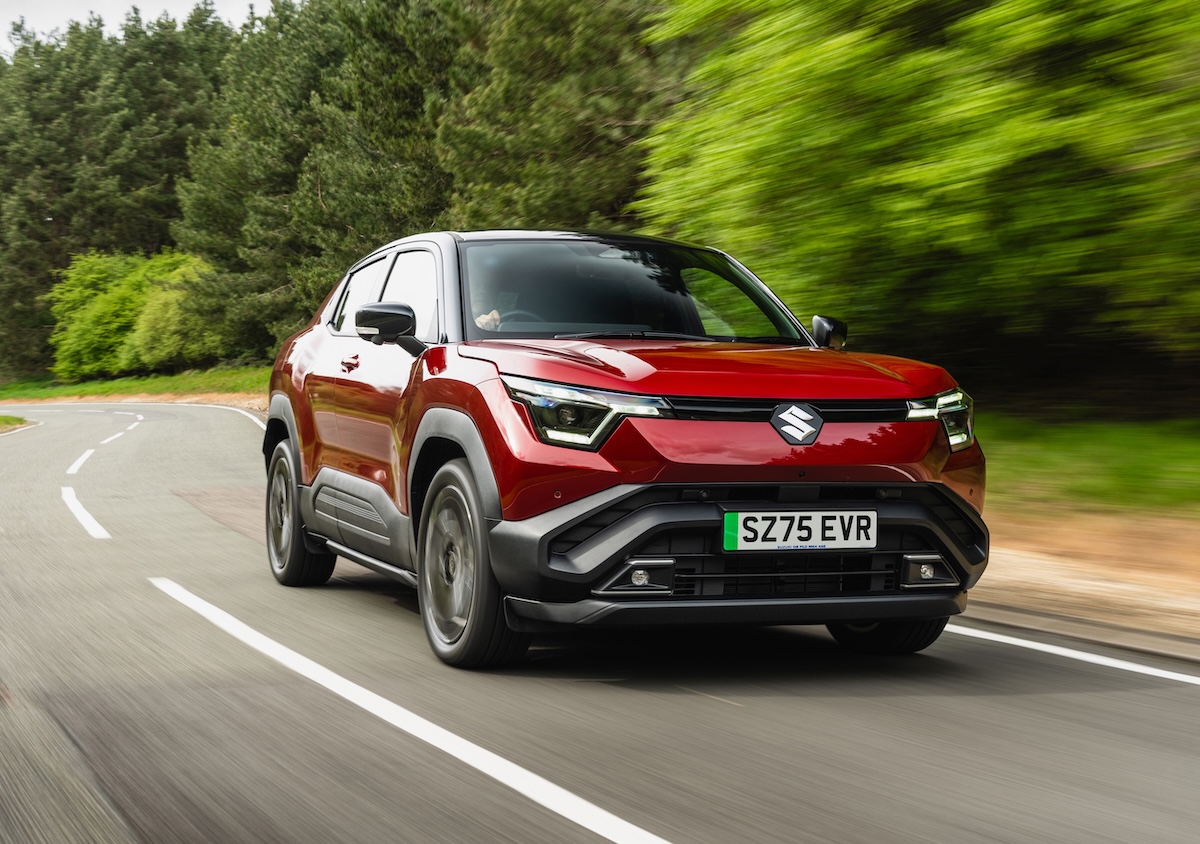
There’s plenty to like about the Suzuki e Vitara. It looks funky inside and out, it’s solidly built, it’s stacked with standard kit, it should be very reliable, and it comes with a very generous warranty package. Suzuki’s self-financed discounts mean that retail prices look very keen to those of most key rivals.
Okay, so it could be more practical, refinement could be better, the ride-and-handling balance could do with a bit more polish, and the range is nothing special. However, the e Vitara is still a capable all-rounder, and perhaps just as importantly, it’s just, somehow, likeable. It also looks like a good-value option in a very crowded class.
What is the Suzuki e Vitara?
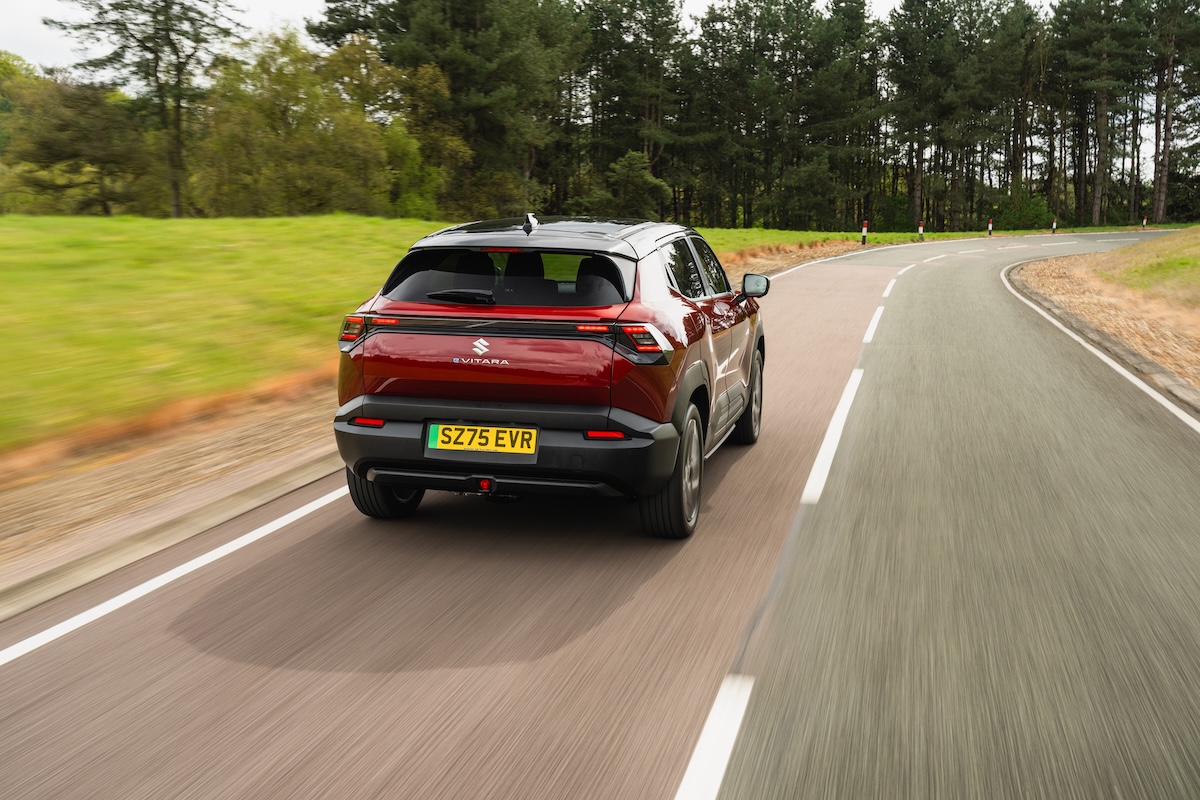
The e Vitara is a significant step for Suzuki, because it’s the brand’s first all-electric car. Like the petrol-powered Suzuki Vitara with which it shares most of its name, it’s a small SUV that’s not much larger in footprint that your average supermini. However, don’t go thinking that this is merely a reengineered version of its namesake where the combustion engine has been hoicked out and replaced with an electric motor. This is an all-new car on an all-new platform, and it’s a very different beast as a result.
The e Vitara shares its platform and much of its tech with the Toyota Urban Cruiser. But while Toyota helped and consulted in various areas, Suzuki did most of the heavy lifting on the project, meaning the car is more Suzuki than Toyota.
Interestingly, it’s also a little bit BYD. That’s because it uses an LFP ‘Blade’ battery pack made by the Chinese company. This comes in two battery sizes, of 49kWh and 61kWh, delivering an official claimed WLTP range figures of between 213 miles and 264 miles, depending on spec. Most versions of the car are front-wheel drive, but it is also available in dual-motor four-wheel drive form (known as ALLGRIP-e), as is traditional with Suzuki.
As a small electric SUV, the e Vitara has countless rivals to fend off, including the Ford Puma Gen-E, Kia EV3, Hyundai Kona Electric and Volvo EX30. Other cars that you might consider alongside the Suzuki could be the Skoda Elroq, Renault 4, Jeep Avenger, and Peugeot e-2008.
How practical is it?
The new Suzuki e Vitara is actually quite a small car at just shy of 4.3 metres long, and even bearing that in mind, its practicality is something of a mixed bag.
There’s lots of space in the front of the e Vitara, and plenty of adjustment for the steering column and driver’s seat: on the range-topping Ultra version, the latter is electrical, making it even easier to find a comfortable driving position. That driving position isn’t massively high compared to some small SUVs, but it’s higher than in most small hatchbacks.
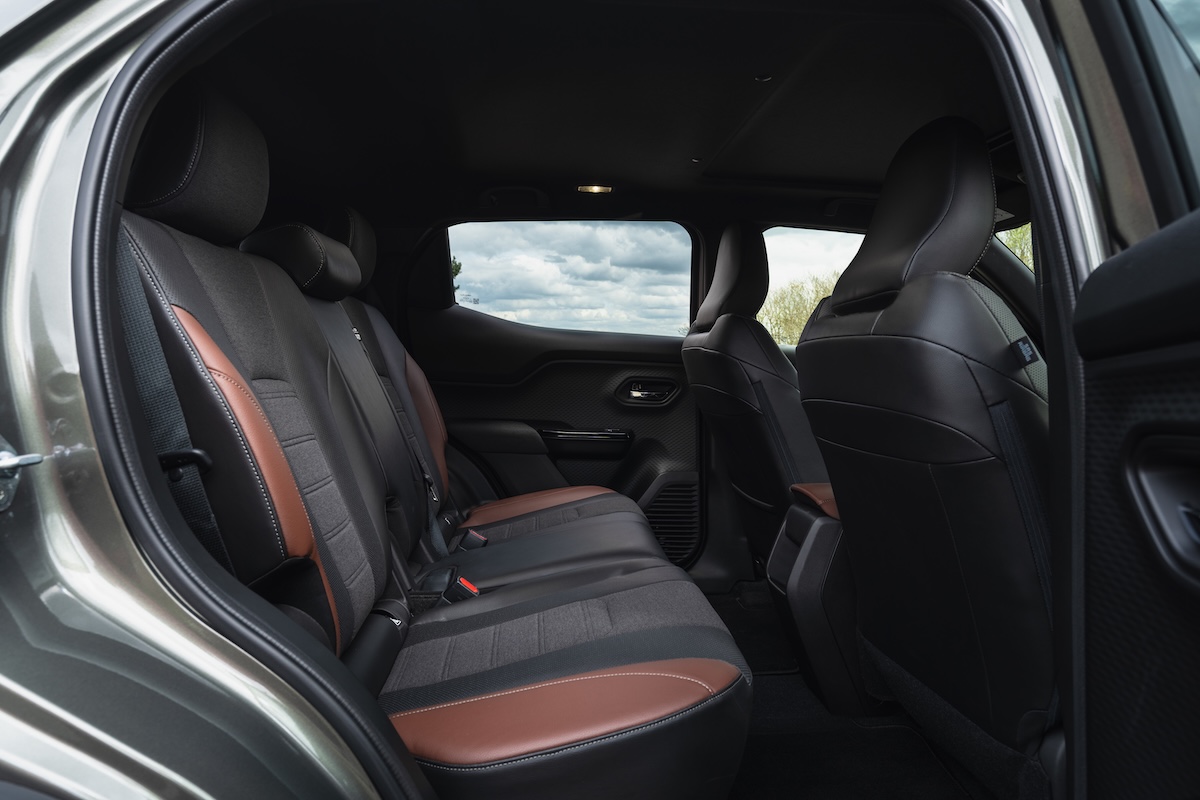
You should also be relatively happy if you’re relegated to the rear seats. In normal circumstances, there’s absolutely loads of legroom, and enough shoulder room for two adults to be very comfortable, or for three to squeeze in for short journeys. Rear headroom isn’t quite so generous, mind. Anyone up to about six foot will be okay, but anyone much taller than that might well detect contact between their hairdo and the headlining.
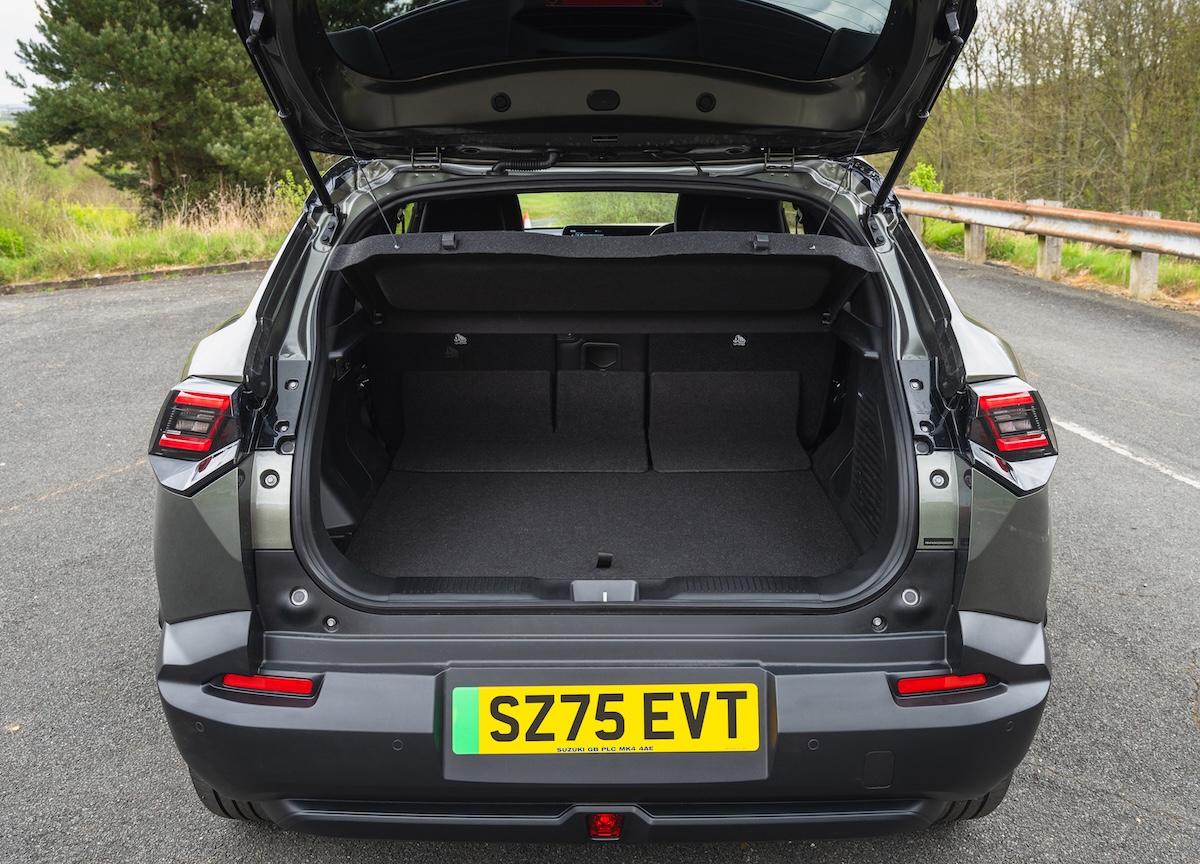
The e Vitara also has another party piece. The rear seats slide, allowing you to sacrifice some of the very generous rear legroom in order to boost boot space. Slide them all the way to the front of their runners, and a six-foot adult will find their knees pressing into the backs of the front seats, but their legs will fit. And doing so boosts the boot space available from 244 litres up to 310 litres. Regardless of where the rear bench sits, the boot space actually looks bigger than the figures suggest, but the figures themselves are still pretty poor for the class. That said, there’s some extra storage space under a false boot floor, which will be handy for stashing charging cables, especially as there’s no ‘frunk’ under the bonnet.
Those back seats also recline, letting their occupants decide how relaxed they want to be, and they fold down in a versatile 40/20/40 split to deliver maximum luggage space of 562 litres (again, not a great figure). The folded backrests sit flush to the false boot floor, giving you a level load area, but they do lie at a slight angle, meaning there’s a gentle slope in the extended loadbay.
In terms of interior quality, the Vitara feels pretty good. The vast majority of the surfaces surrounding you have a hard finish, rather than a squishy, cushioned one, but they’re textured in such a way that they still manage to look and feel reasonably appealing, and the mixture of textures and colours makes the cabin look upbeat and interesting. It should stand up well to the rigours of family life, too.
What’s it like to drive?
When it comes to powertrains, there are three distinct versions of the all-electric Suzuki e Vitara. The entry-level car has a relatively small 49kWh battery, giving it an official WLTP range figure of 213 miles. This powers a single electric motor on the front axle, a motor that delivers 142bhp and powers the car from 0-62mph in 9.6 seconds.
The next version also has a single, front-mounted electric motor, but with a splash more power at 172bhp, making it capable of seeing off the 0-62mph dash in 8.7 seconds. More importantly, it also has a larger 61kWh battery pack, extending the car’s combined WLTP range up to 264 miles.
This 61kWh battery is shared by the range-topping version, but range drops to 245 miles. That’s because as well as the front-mounted motor, a second rear-mounted motor is added to give four-wheel drive, in true Suzuki tradition. The total power output only rises to 181bhp, but there’s a big boost in torque, from 142lb ft in the other versions to 226lb ft. The 0-62mph time of the all-wheel drive version is 7.4 seconds.
We spent most time in the single-motor car with the larger battery. The power delivery of this variant actually feels slightly unconventional for an electric car. While most EVs pull hardest off the line and then the acceleration tails off as you go faster, the e Vitara’s acceleration actually feels pretty moderate and restrained off the mark, and it’s when you nail the accelerator when you’re already doing 30mph or so that the acceleration feels the strongest, and the rate of acceleration feels more linear than in most EVs as you approach the top end.
There are three driving modes, Eco, Normal and Sport. These exist to vary the car’s powertrain characteristics to maximise range or performance according to your prevailing needs. The more sensible ones don’t limit the amount of power in any way: it’s just that you have to press the pedal a little further in order to get maximum output, and the accelerator responses are also dialled back a bit (which is a good thing, if you ask us, because the e Vitara's accelerator is so sensitive that it can be difficult to maintain a constant speed in anything other than the Eco drive mode.
There is regenerative braking, adjustable in three stages. There’s a button to activate and deactivate it on the centre console, which is good, but the three-stage adjustment has to be done through the touchscreen rather than with more convenient steering wheel paddles, which is more of a pain. Even the strongest regen’ mode isn’t particularly strong, and certainly nowhere near the one-pedal experience offered by some EVs.
We've also tested the four-wheel-drive version, which is fairly unconventional in the small electric SUV class. It’s an on-demand system, whereby the front motor drives the car in normal circumstances, and the weaker rear motor chips in either when the front wheels start to slip - and the response to this is instant, Suzuki claims - or when the driver demands full acceleration. We tried the car on the road, where it feels a fraction nippier off the mark than its single-motor siblings, and on a fairly undemanding off-road course. And we discovered that while you won’t be traversing the Pyrenees in it anytime soon, it’ll deal with muddy fields and steep-ish slopes.
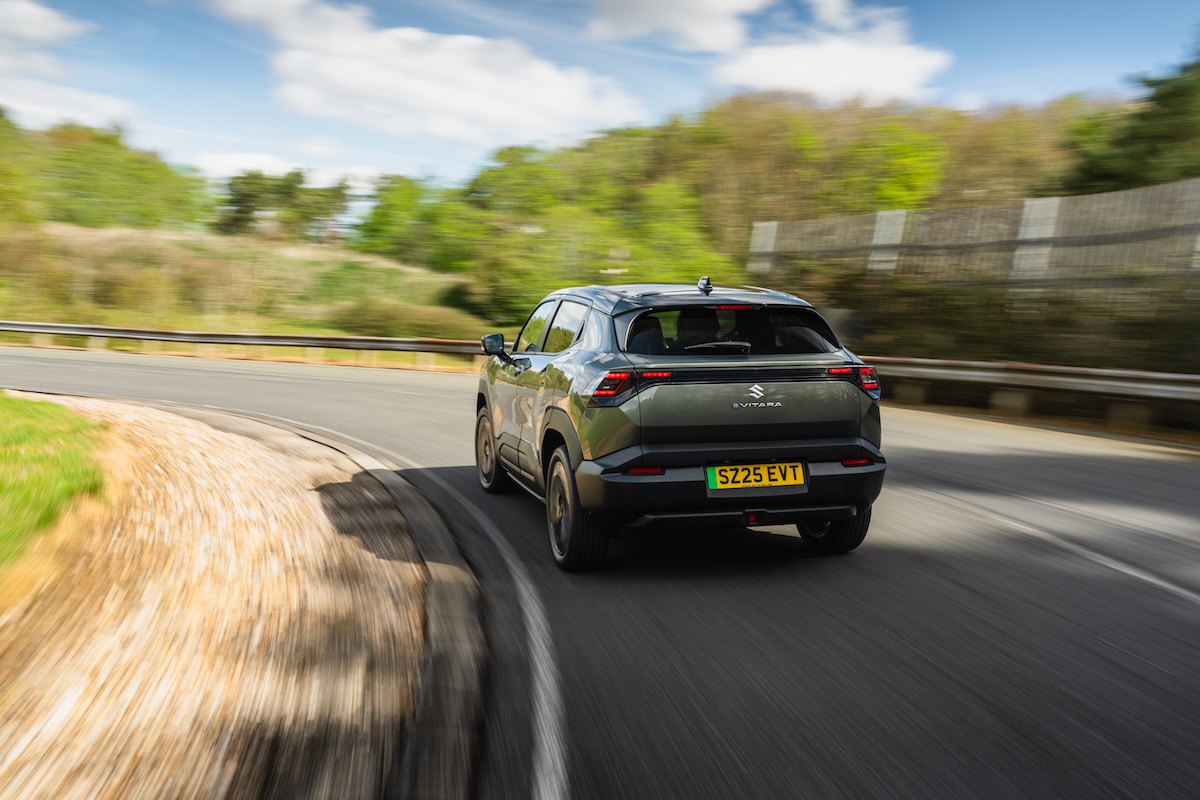
Regardless of powertrain the Vitara’s suspension is soft. The good news is that, much of the time, this translates into a smooth and comfortable ride, the suspension taking the sting out of most bumps and potholes reasonably effectively, particularly at slower speeds. The less-good news is that the body tends to pitch and bounce on undulating surfaces, and despite the softness, the suspension can still struggle to deal with some high-frequency surface imperfections, specifically ripply or grainy ones. There is an unsettled feel some of the time, then, but the ride is generally fine.
The soft suspension also results in a fair amount of body roll in corners, and the car also feels rather heavy in corners. But while this isn’t a car that relishes fast direction changes (or even moderately paced ones for that matter), it doesn’t feel too clumsy and there’s plenty of grip regardless of how many driven wheels you have. The steering is a little numb and artificial-feeling, but it’s nicely weighted and reacts consistently.
Refinement is also perhaps not what you might expect it to be. There’s predictably little in the way of noise from the all-electric powertrain, but road- and wind noise can both be rather pronounced, even at fairly moderate speeds.
Technology, equipment & infotainment
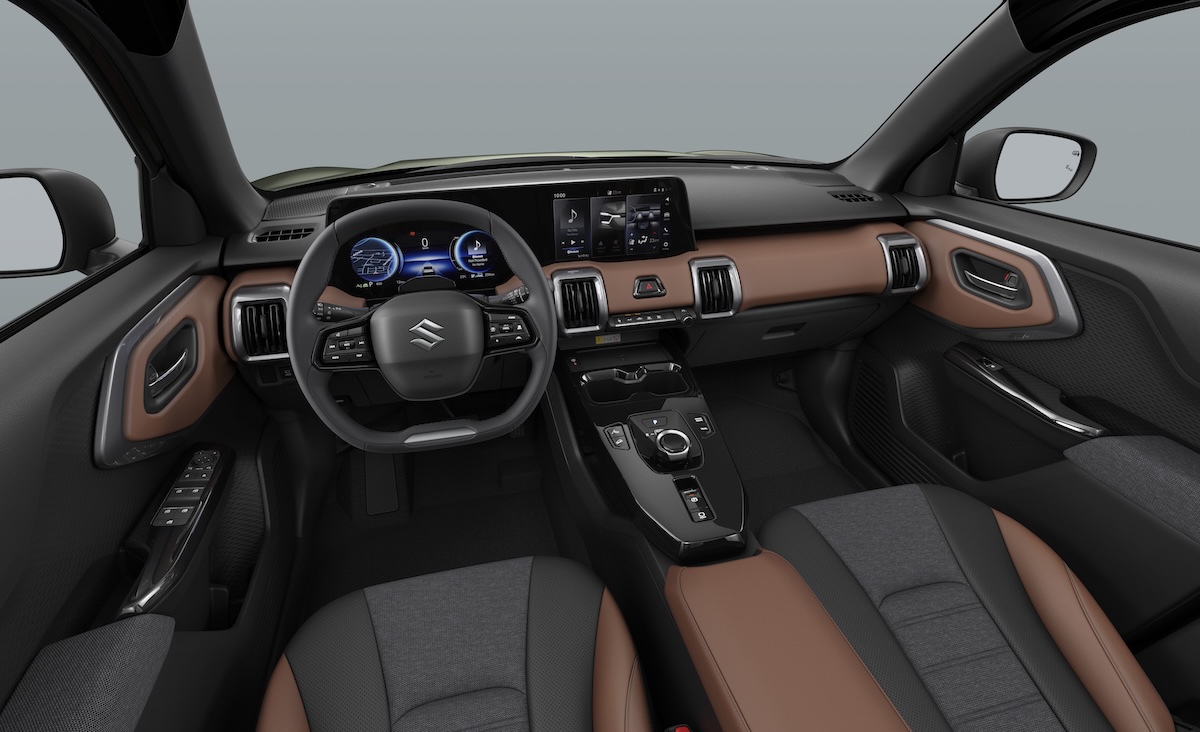
All versions of the e Vitara have the same core infotainment system. As is very much the fashion these days, there are two large digital screens placed side-by-side on the dashboard: the 10.25-inch one behind the steering wheel displays your general driving information, while the 10.1-inch one to its left, in the middle of the dashboard, takes care of the infotainment functionality.
Functionality includes all the stuff you’d expect, such as Bluetooth, DAB, built-in navigation, four USB ports, and wireless connection to both Apple CarPlay and Android Auto. Higher-spec Ultra trim adds a wireless phone charger and premium audio with a subwoofer to the roster.
Without wanting to sound negative, we’ll start with the bad bits of the system. For starters, the driver display screen isn’t very customisable: there are only three layouts to choose from, and they all look pretty similar and display pretty much the same information. The central screen also has very limited customisability, and as you switch from function to function it's not only laggy, but you’re served up irritating on-screen animations to signify this fact, which take too long and get in your way.
On the more positive side, there are handy shortcut icons either side of the screen to help you navigate to the function you want, and the interface is generally pretty logical.
And as an added bonus, there are physical buttons and switches in the middle of the dashboard for controlling the air-con. Well, for controlling the cabin temperature and fan speed, that is. Anything more involved than that - such as changing the direction of the airflow - still has to be operated through the touchscreen, but it’s a start, and we’ll take it.
Two trim levels are available. The first one is called Motion, and even this is impressively well equipped. When combined with the entry-level 49kWh battery option, the Motion comes with 18-inch alloy wheels, rear privacy glass, front- and rear parking sensors, rear-view camera, a heat pump, keyless entry and start, adaptive cruise control, front- and rear powered windows, interior ambient lighting, fabric upholstery, electric parking brake, automatic climate control air conditioning, automatic lights and wipers, and electrically adjusting and folding door mirrors.
Upgrade to the 2WD Motion model with the larger 61kWh battery, and heated front seats, a heated steering wheel, and heated door mirrors are added to the roster, while if you upgrade further to the 4x4 model, you also get hill descent control.
Upgrade to the Ultra trim level, meanwhile, and you get 19-inch alloys, adaptive high-beam headlights, LED front foglamps, 360-degree cameras, panoramic glass sunroof (although it doesn't open), part-leatherette upholstery, and a power-adjustable driver’s seat.
Suzuki e Vitara running costs
Viewed against comparable versions of its key rivals, the e Vitara is similar in price to the Ford Puma Gen-E, usefully cheaper than the Kia EV3 and considerably cheaper than both the Hyundai Kona Electric and Volvo EX30. A Jaecoo 5 is cheaper still, but the Suzuki is a considerably better car.
As we’ve already said, the entry-level car has a relatively small 49kWh battery, giving it an official WLTP range of 213 miles. The other front-wheel drive version with the larger 61kWh battery pack has a combined WLTP range of up to 264 miles, the longest of any e Vitara. The four-wheel-drive version shares that same 61kWh battery, but the extra drain on it drops the range figure to 245 miles.
As always, these range figures should very much be looked upon as a best-case scenario. Even in optimum conditions, you should bank on getting 15-20% less, and you’ll see real-world figures drop off considerably more in cold weather, or with prolonged high-speed motorway running. It’s good that all e Vitaras come with a standard heat pump for more efficient cabin heating, and this should help you get a little closer to the official figures in the real world.
A 10%-100% charge of the entry-level 49kWh car on a regular 7.4kW home charger will take around 6.5 hours, and cost around £12. With the 61kWh car, the same charge on the same connection will take around 9 hours, and cost around £14. That’s not the full story, though. Get yourself on a domestic power tariff that allows you to charge up your car on heavily discounted off-peak electricity, and you’ll likely pay a third of those costs, maybe even less.
The most expensive way of getting charge into your car will be a public DC rapid charger. Prices of around 90p per kWh aren’t uncommon on these, and at that sort of cost, then a 10%-80% charge of the 49kWh will cost £43, while the same top up of the 61kWh car will cost around £54. It won’t even be that quick - around 45 minutes - as the car’s maximum DC charging speed is just 70kW.
EV drivers no longer swerve VED road tax payments, so your car will be liable for the same flat rate as drivers of petrol and diesel cars. At least the prices are low enough that you won’t be clobbered by the hefty luxury car surcharge that’s applicable to cars that cost over £40,000 when brand new.
Suzuki e Vitara reliability
You often find Japanese brands sitting on, or near, the top of the various reliability surveys doing the rounds, and that’s very much the case with Suzuki. The latest What Car? Reliability Survey, for instance, places the brand third out of the 30 manufacturers considered in the study. That’s a brilliant result.
The combustion-engined Vitara was the brand’s second-most reliable car in the study (behind the Swift supermini) but you can’t read too much into that because despite the similarity in name, the e Vitara sits on an entirely different platform. Ultimate reliability is still a bit of a mystery, then, but the initial signs are good.
Also good is Suzuki’s warranty. The firm has been playing around with its warranty offering in recent years, and it’s been getting better and better. Nowadays, the firm provides bog-standard 60,000-mile, three-year warranty initially, but when you get your car serviced annually at a Suzuki main dealer, your warranty is automatically topped up by an additional year, up to a maximum of 10 years, 100,000 miles. And, if your car is serviced outside the dealer network at any point, then provided your car still sits within the allotted limits, you can bring it back to the dealer network next time and - subject to a vehicle healthcheck - the additional warranty can be reapplied.
What’s more, the eight-year battery warranty that legislation demands of manufacturers has also been topped up by Suzuki to meet the same 10-year, 100,000-mile mark.
- The e Vitara’s roster of standard driver assistance tech includes adaptive cruise control, lane keep assist, lane departure prevention, traffic sign recognition and intelligent speed limit assist, blind spot monitoring, rear cross traffic alert, and a driver attention monitor.
- Turning off the more annoying of these systems involves delving into a couple of on-screen menus and axing them individually, which is rather complicated and time-consuming, but there’s a favourites button on the steering wheel that can be configured to carry out the same task in just a few taps. If all those driver aids aren’t enough to prevent you from having a smash in the first place, then there are seven airbags to help keep you from harm, along with two Isofix points for easily securing child seats. There’s also a multi-collision braking system that locks on the anchors in the event of an accident to help prevent further collisions.
- Despite the generous amount of standard safety gear provided, the e Vitara has only been awarded four stars out of five by the crash-test boffins at Euro NCAP.
- If you want the cheapest e Vitara, and only do low mileages: The fact is that not all drivers need a massive range because they only ever do short journeys. If that’s you, then you’ll save a stack of cash by going for the entry-level 49kWh version. Why have all that extra battery capacity sitting on your driveway if you’re never going to use it?
- If you want the best balance of abilities: We reckon the sweet spot in the range for most people will be the longer-range front-wheel-drive version in entry-level Motion trim. It’s 61kWh battery gives it the best range of the bunch at 264 miles, and it comes with all the kit you really need, plus a bit more. The sub-£30,000 price (with Suzuki’s discount) makes it look like good value, too.
- If you want all the bells and whistles: The Ultra-trimmed car does have some desirable items of equipment over-and-above what you get with the Motion. Do be aware, though, that the upgrade is a costly one at almost £3,000, so make sure those extra bits and pieces are really worth it to you.
- If you want to go off the beaten track: We’ve tried the four-wheel drive version of the e Vitara off-road, and it copes well with slippery slopes and muddy fields. Not surprising when Suzuki has several decades of 4x4 experience under its belt. Don’t expect it to be as capable in the rough stuff as a Suzuki Jimny, though: it simply doesn’t have the ground clearance for that.


