Geely Starray 2026 review | Solid plug-in hybrid family SUV at a bargain price

Pros and cons
What we like
Extremely affordable
Plug-in hybrid range and efficiency
Spacious and well-equipped interior
What to consider
Not especially dynamic to drive
Engine is loud when worked hard
Onboard tech takes some getting used to
The CarGurus verdict
The Geely Starray is a fairly well-rounded machine that may surprise some with what it offers. The first headline is ultra-keen pricing, with the entry model starting from under £30k, and even the top-spec version offered for under £35k. This is thousands less than plug-in hybrid rivals – yet the Starray also offers more space, more equipment and more tech than many of them. The long-range version is particularly compelling, and is our pick of the bunch.
Of course, it has several Chinese-brand rivals all offering similar virtues, btu the Geely Starray adds a bit more European polish on top. You can sense the Lotus development that’s gone into it – not to make it a dynamic delight, but to give it the confident stability of more established competitors. For the money, it’s worth at least taking out for a test drive, given the potential savings over the establishment.
out of 5 expert review
What is the Geely Starray?
The Geely Starray is the plug-in hybrid alternative to the Chinese firm’s first car to launch in the UK, the electric Geely EX5. The two are, drivetrain apart, basically identical, providing a two-pronged challenge to established family SUVs such as the Kia Sportage, Nissan Qashqai, Volkswagen Tiguan, Hyundai Tucson and Ford Kuga. The Starray is especially compelling because it offers long-range plug-in hybrid tech for a price that undercuts many rivals’ conventional petrol alternatives.
There's a growing number of Chinese rivals to the Geely Starray, of course, with alternatives including the BYD Sealion 5, MG HS, Jaecoo 7, Omoda 5, Chery Tiggo 7 and more. The list grows almost by the week.
Geely is most well-known for being the parent firm of Volvo, Lotus, Polestar and Smart, amongst others. Introducing its own name into the UK allows it to offer a mainstream alternative to these premium brands – and it has heady goals for the UK, targeting 100,000 sales a year. That’s a level that would put it right up with Kia, Hyundai and others.
Geely is rapidly growing a UK dealer network to help deliver on this; the aim is to have around 100 dealers by the end of 2026, with further growth after that to coincide with the arrival of many more new models. These will include models both smaller and larger than the Starray SUV.
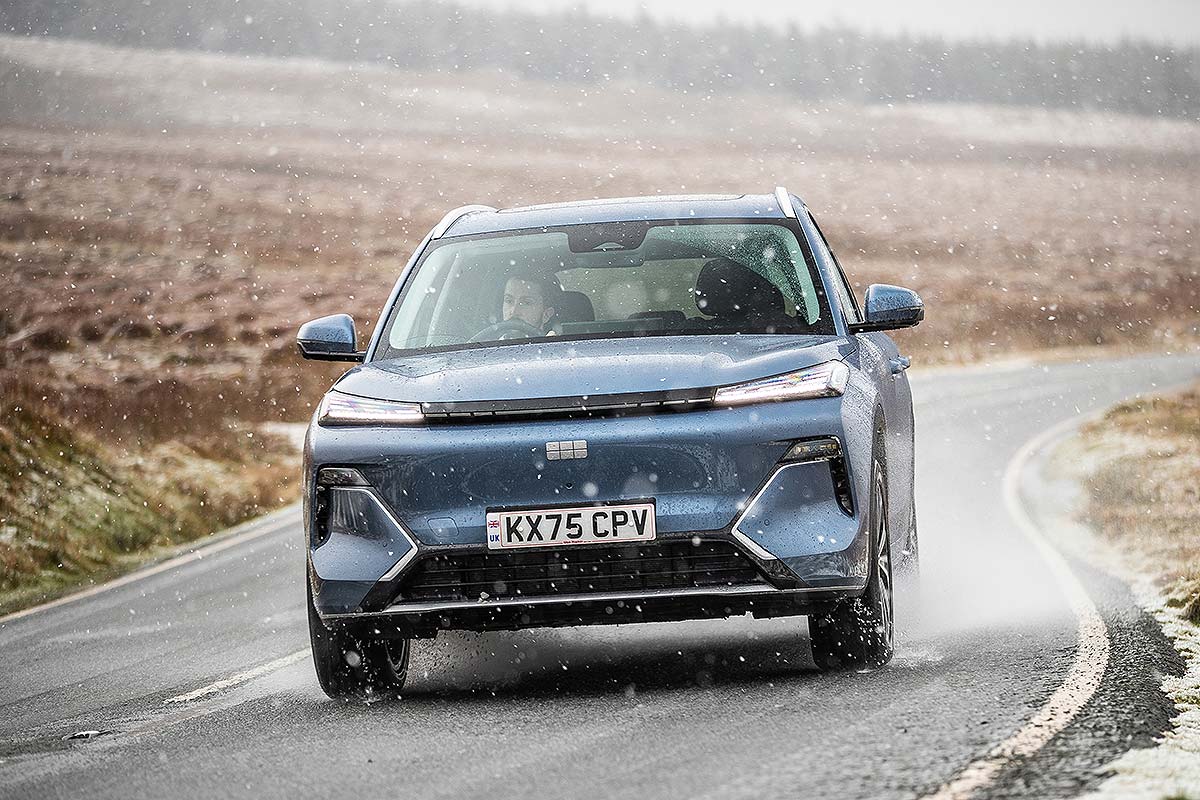
The Geely Starray has an understated appearance on the outside, with smooth and rather generic styling. It’s nicely proportioned, and the Geely logo is interesting, but it doesn’t stand out on the road like a Jaecoo 7 does. It’s a similar story inside, although the Tesla-inspired interior is nicely built, with some high-quality materials in evidence. The key is rather cool; it’s white and pebble-shaped, a bit like an Apple Airpods case.
There are three trim levels, called Pro, Max and Ultra. Pro and Max have an 18.4kWh battery, which is paired with a 1.5-litre petrol engine. Ultra has the same engine but a larger 29.8kWh battery. All models have a 258bhp power output, driving the front wheels, for 0-62mph in 8.0 seconds; the difference comes in the electric range, with the smaller battery giving a 51-mile EV range, which extends to 84 miles with the larger battery.
All Geely Starray are extremely well-priced. It starts from just under £30,000 for the entry-level Pro version, stretching to just under £35k for the top-spec, biggest-battery Ultra model. When you clock that the cheapest Volkswagen Tiguan plug-in hybrid costs over £43k, you can see how compelling the Geely Starray looks on paper. But what is it like in practice?

Practicality
How practical is it?
The Geely Starray is a fairly large SUV, measuring over 4.7 metres long. This positions it between the strong-selling Volkswagen Tiguan and its larger seven-seat sibling, the Tayron, with the five-seat Starray firmly targeting the former with the promise of better space and practicality.
It feels roomy from behind the wheel, with high-set seats giving a good view out. They’re trimmed in what Geely calls ‘perforated PVC’, which many other car firms jazz up as ‘vegan leather’. Max and Ultra cars get ventilated seats as well as heated ones, although the six-way electric driver’s seat lacks adjustability at the front of the seat base – it’s rather flat and doesn’t support your thighs as well as it could. We also noticed the front seat headrests could stick into your shoulders if you don’t raise them up, although this is probably sensible as it will help boost safety. Headroom in the front is vast, even in Max and Ultra models with their standard panoramic glass roofs.
There’s loads of headroom in the rear too, along with acres of legroom. Compared to many mainstream rivals, the Geely Starray feels like a limo in the rear, with cross-your-legs space even behind taller front seat occupants. The floor is completely flat, adding to the airy feel, and there’s generous foot room under the front seats. It’s lounge-like and unrestricted – although some may find the angle of the rear seat backrest a bit too lounge-like; it’s quite reclined, and you can’t reposition it to a more upright angle.
There’s lots of clever cabin stowage spaces – Geely’s counted more than 30 of them. The centre cubby is enormous, the door bins are generous and the wireless charging spots are very well-located, Tesla-like, on the centre console. Rear seat passengers have their own air conditioning vents, USB charging sockets and a central arm rest. Ambient lighting features inside, with occupants able to blend their preferred hue from 256 different colours.
By European standards, some Chinese cars don’t have very big boots, but the Geely Starray doesn’t stumble here. The 528-litre quoted capacity is fairly competitive (and better than the electric Geely EX5), while folding the rear seats expands it to over 2,000 litres – a figure more commonly associated with the largest estate cars. The space is a little shallow below the fold-out tonneau cover, although this does make it easier to load, and the boot is wide as well – complete with a 1,122mm aperture. Max and Ultra models have a standard power tailgate.
The Geely Starray has a minor practicality gripe that’s shared with other Chinese SUVs; the electric window switches work in the ‘opposite’ direction. Even after hours behind the wheel, you’ll still be pressing the button the wrong way both to lower and raise the windows (and if you’re not, your passengers will be complaining to you about it). Surely it can’t be hard to program them to work in the ‘correct’ way?
We must also mention the noisy climate control, which always seems to be working overtime in ‘auto’ mode. It’s sometimes so frustrating, you’ll turn the fan down just to calm things down, although this does negate the benefit of standard climate control. Again, this is an issue it shares with other Chinese-brand rivals.

Driving
What's it like to drive?
The Geely Starray is designed, like many Chinese ‘range extender’ plug-in hybrids, to mimic an EV even when the battery is discharged. It starts up and generally always pulls away in EV mode, and tries to keep the engine off for as long as possible. If you keep the battery topped up, you’ll probably rarely hear the engine – the only time it will start up will be an occasional maintenance cycle to keep all the oily bits healthy.
In town, this gives a nice gliding sensation, just like in the Geely EX5. This is where the bigger Ultra battery appeals, because you’ll be able to enjoy this electric running for more than 30 miles longer. It’s a shame the accelerator pedal isn’t more responsive though; little happens in the first part of the pedal’s travel, resulting in a noticeable delay when trying to pull sharply out of junctions. Stamp on it to overcome this, and power will arrive in a rush, causing front wheel slip and harsh intervention from the traction control system.
Some of its rivals have uncommonly smooth and silent engines, but the Geely Starray isn’t one of them. The engine isn’t particularly raucous in everyday use, but you will still hear (and feel) it when it kicks in. And if you demand maximum power, the engine will become loud, boomy and intrusive. A BYD Sealion 5 is better in this regard, as is a Jaecoo 7.
Dynamically, the Geely Starray is a nicely laid-back machine. The suspension is quite soft, soaking up inner city lumps and bumps smoothly. You needn’t fear the plethora of potholes that scar so many British roads these days, despite those fairly large-diameter 19-inch alloys. It rarely crashes over intrusions at higher speeds either, although the wheels do generate a bit of underlying fidget and patter that means it’s not totally smooth.
The Geely Starray is a bit soft through corners too, with a bit of body roll as it leans into bends. It stays the right side of being wallowy and mushy though, and feels more dynamically well-sorted than some of its Chinese rivals. It almost has a European feel to it – indicating a good amount of tuning over here to hone it for Western consumption (Geely says it worked with Lotus here). Fitting premium tyres is a good sign too, with the test car’s Goodyear rubber offering good all-weather grip and confidence.
The Geely Starray has fairly well-weighted steering as well, with decent accuracy, once you’ve steered past an initial softness in turn-in response. You can relax at higher speeds without it feeling nervous, which makes long journeys that bit more comfortable. Again, it’s much better here than the BYD Sealion 5 and Jaecoo 7. The brakes are fairly linear as well – and there are several different levels of regenerative braking to toggle through.
Tech and equipment
Technology, equipment & infotainment
The Geely Starray is a tech-packed machine, with almost everything masterminded through its crisp 15.4-inch touchscreen (and complementary 10.2-inch driver display). The system offers over-the-air updates, so is kept fully updated, and the 4G network connectivity facilitates standard online navigation across the range. Geely gives you two years’ free 4G connectivity, with a monthly cap of 2GB.
It’s a pretty involved system at first glance. With no buttons, it’s entirely dependent on touching the screen and navigating between menus. Fixed shortcut keys along the bottom aim to guide you here, while there’s a layer of programmable widgets above this. Swiping down from the top of the screen brings up yet another layout of customisable widgets. It’s all a bit much at first, but you quickly get used to the essentials.
There’s a packed Geely app store built into the infotainment screen, allowing third-party apps to be downloaded. There’s also a Geely smartphone app, although this still seems to be in its infancy here in the UK, and will need time to match the sophistication of more established rivals’ own apps.
Wireless Apple CarPlay and Android Auto are standard, and extra marks to Geely for how they take up almost the entire screen – while still retaining the all-important shortcuts along the bottom of the screen. This is the best of both worlds, letting you use smartphone mirroring without having to go through loops just to change the temperature (because the icon is so small, this is actually rather fiddly to do on the move) or adjust the door mirrors.
Speaking of which, Geely is another brand that has removed physical switches for the door mirrors, forcing you to do it through the touchscreen. This, again, is fiddly, although if you press the door mirrors on the big picture of the Starray on the home screen, it does take you directly into the control, which is at least something.
The Geely Starray also has a brilliant customisable button on the steering wheel. This lets you choose a customisable driver profile – which extends to your preferred ADAS settings, such as disabling lane-keep assist and audible speed limit warnings. Two presses are all it takes, and you don’t even have to look away from the road to engage it. It’s a model for other car manufacturers.
Max and Ultra models have a smart 13.8-inch head-up display as standard, which packs in some useful functionality to help everyday driving. The AI voice assistant is fairly comprehensive too, allowing voice control of things such as sat nav, climate control and even opening and closing the sunroof.
Geely Starray Max and Ultra also have the firm’s own-brand Flyme sound system. This 1,000W setup has 16 speakers that include headrest-mounted speakers for the driver, which serves up immersive sound and also helps isolate sat nav instructions so as not to disturb others. It’s a decent system, and the stylised speaker grilles have a premium appearance.

Running costs
Geely Starray running costs
The average daily mileage is less than 30 miles, so if you’re able to charge up your Geely Starray overnight, it doesn’t matter which size battery you go for, you’ll be saving a fortune on fuel costs. While the larger battery offers 84 miles’ range, even the standard battery delivers up to 51 miles, which can really help cut running costs.
The difference comes when journeys lengthen. This is where the extra range of the Geely Starray Ultra’s larger battery will extend that inner-city EV running and keep the engine switched off for longer. On-paper fuel economy leaps from 117mpg to 201mpg: neither figure is very realistic, but it’s still fair to say you’ll see better fuel economy figures from the bigger-battery version. There’s a CO2 benefit too – just 32g/km, compared to 54g/km – which gives a minuscule £20 saving in first-year VED road tax.
In practice, we regularly saw an average of 70-80mpg or more showing on the driver display, even without frequently plugging in the battery. Over a week’s intensive use, the fuel gauge barely budged; it will be interesting to test one over a longer time period, as the potential seems set for some very impressive economy figures.
Incidentally, you get two (tiny) fuel gauges in the Geely Starray: a green one shows how many miles’ battery charge you have, with a blue one indicating remaining miles from the fuel tank.
DC rapid charging is standard on both battery sizes, but it’s a rather slow 30kW rate on the smaller battery. Because of its size, this will still take it from 30-80% in 20 minutes, but the faster 60kWh DC speed for the bigger 29.8kWh battery will be preferable. It replenishes more range in less time, taking 16 minutes to go from 30-80%.
The bigger battery also brings lower Benefit-in-Kind rates for company car drivers too – 7% instead of 10%. This means, bizarrely, the pricier model will cost less in tax per month than its cheaper brethren…
The Geely Starray stacks up pretty well in terms of car insurance as well. Geely’s worked hard to ensure it’s secure and easy to repair in the UK, which means ratings start from group 30, with even the Ultra only in group 32. By way of comparison, a Honda CR-V plug-in hybrid is in group 37, while a comparable Volkswagen Tiguan eHybrid starts from group 27.
Service intervals do seem a bit short on the Geely Starray, though – every 12 months or 10,000 miles. At least the first service is free.

Geely Starray reliability
Some Chinese models have a bit of a mixed record here. Geely will be hoping it doesn’t join other brands in being complained about on owners’ forums. A generous eight-year, 125,000-mile base warranty is a highlight – it includes the high-voltage plug-in hybrid battery too – although you might want to read the small print carefully as there will of course be exceptions.
All new Geely Starray include an impressive four years’ breakdown cover and roadside assistance. The hope is that this won’t be called upon, although it will take some time for initial reliability performance in the UK to become clear.


What owners say
Three things to know
- Families can choose the Geely Starray safe in the confidence it has a glowing safety score rating from Euro NCAP. It earned the maximum five-star rating when tested, with highlights including a 90% score for adult occupant protection, and 86% for vulnerable road users.
- The Geely Starray is very slippery through the air. It has a Cd drag factor Cd of just 0.28. The firm says this is thanks to more than 150 hours’ wind tunnel testing. It helps ensure the Starray is efficient at higher speeds, boosting both its EV range and helping cut fuel consumption.
- Geely is offering some incredibly competitive finance deals on the Starray. Deposits are low, monthly payments are low, and 0% APR means the interest rate couldn’t be lower. The deals are intended to kickstart interest in this new brand and it’s certainly worth visiting a dealer to see how the numbers may stack up for you.
Which one to buy
- The best all-rounder: It has to be the Geely Starray Ultra, the one with the biggest battery. It costs just £5,000 more than the base version, yet has the longest EV range, the best fuel economy, and easily the most comprehensive standard spec.
- The cheapest Geely Starray: The range opens for under £30k with the Pro version. Even this has a 51-mile EV range from the plug-in hybrid battery, along with a standard spec that includes electric heated front seats, touchscreen infotainment, keyless entry plus wireless Apple CarPlay and Android Auto.
- The most equipment for the best price: Both Max and Ultra have a similarly comprehensive standard spec. The Max is £2,300 less than Ultra due to its smaller battery, so if you’re not bothered about seeking the maximum EV range, the saving is there for the taking. We’d still advise spending the extra though, as Ultra models are likely to be more in demand on the secondhand market.


