Nissan Ariya 2026 review | A refined and sure-footed electric SUV
Nissan Ariya cars for sale
3.0
Expert review
Pros
Practical interior
Attractive, modern cabin design
Relaxing to drive
Cons
Ride comfort could be smoother
Boot is adequate but not exceptional
Expensive to buy

The CarGurus verdict
The Nissan Ariya is a bold, appealing car that is competitive in key areas including driving range, practicality and perceived quality. It has one of the classiest interiors of the many not-quite-premium electric SUVs it competes with. Ride comfort could be better, and there are rivals such as the Kia EV6 that are more fun to drive. Other alternatives, such as the Skoda Enyaq, are also more comfortable, similarly practical and – while more conventional and less stylish inside – usefully cheaper to buy.
So, the Nissan Ariya isn’t without significant competition, and it does lack a unique selling point in an increasingly hard-fought class. For all that, the Ariya’s style, generous equipment and impressive interior still make for a likeable family SUV.

What is the Nissan Ariya?
The Nissan Ariya is a five-seat electric SUV that is a touch longer than a Nissan Qashqai, but slightly shorter than a Nissan X-Trail. It’s more style-focused than most Nissan models, with an SUV-coupe silhouette and a bold, shark-like fascia providing a distinctive, upmarket appearance. Expect this look to filter into more Nissan models over time.
You can choose from two-wheel-drive or all-wheel-drive models, and there are two lithium-ion battery options: 63kWh or 87kWh. These, offer an official, WLTP-tested driving range of between 247 and 330 miles. Prices start from £35,000 for the entry-level, 63kWh Ariya Engage, or £33,500 once you take the UK Government’s £1,500 electric car grant into account. The regular range stretches to £50,500 (including the £1,500 grant) for the all-wheel-drive Nissan Ariya e-4orce with its substantial 87kWh battery pack.
At the very top of the range, there is the £56,630 Nissan Ariya Nismo. The performance-focused halo of the range, it basks in the reflected glory of cars such as the Nissan 370Z Nismo and GT-R Nismo.
Rivals for the Ariya include the Skoda Enyaq, Volkswagen ID.4, Audi Q4 e-tron, Ford Mustang Mach-E, Kia EV6 and EV5, Hyundai Ioniq 5 and Tesla Model Y.

How practical is it?
The Ariya is just as practical as a Ford Mustang Mach-E or Volkswagen ID.4. In other words, it’s a very practical car indeed. The boot is bigger in front-wheel-drive variants – 466 litres compared with 408 litres in all-wheel-drive models – as there is no second electric motor at the rear to take up space. Nonetheless, you’ll still find plenty of room in the deep boot for a baby buggy or large dog, so any Ariya will suit family life very well. Fold down the rear seats and in the front-wheel-drive car you’ll be left with 1,310 litres for luggage. One interesting point to note: the latest Nissan Leaf (now a crossover SUV, rather than a hatchback) has a 438-litre boot.
The three-person rear bench offers masses of legroom and headroom, and the flat floor means that even somebody sitting in the middle will find plenty of space for their feet.
It's very comfortable up front, too, even for very tall people. The seats are broadly adjustable and comfortable, and the cabin feels a good deal more premium than that of the Nissan Qashqai.
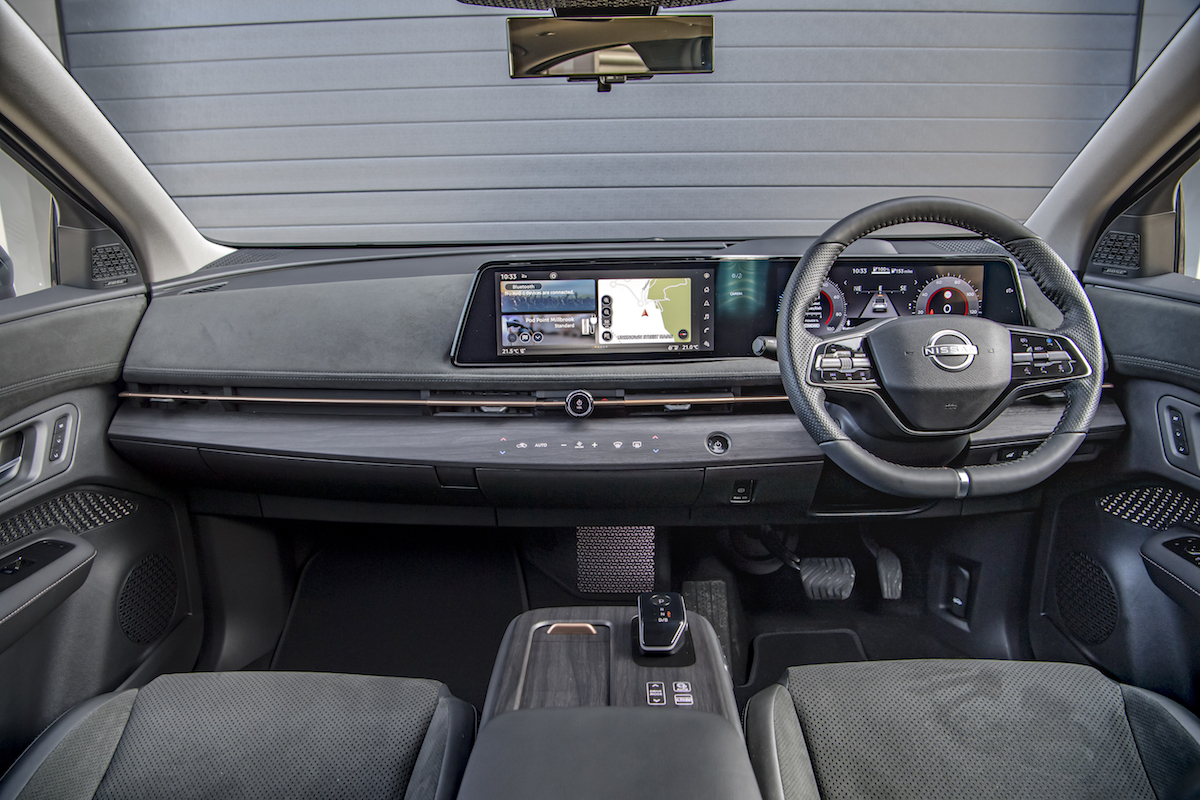
Nissan clearly has ambitions to nibble away at Audi, BMW, Mercedes-Benz and Volvo sales with the Ariya, which has a very minimalist interior that is garnished with a wood finish. This gives it something of the boutique, Scandi-design feel that Volvo has perfected, complete with touch-sensitive buttons on the wood panels that are invisible until the car is switched on. They’re not quite as intuitive to use, or as easy to push, as traditional physical switches, but they do look brilliant and compliment the slick, hi-tech cabin.
Nissan offers accessories such as reversible boot liners, mud guards, tow bars, roof rails and a roof box if you want to add extra practicality. That said, the range of add-ons feels weak compared to those available for the Skoda Enyaq and Elroq.

What's it like to drive?
The Ariya is very slick to drive, but it’s not the smoothest riding or most involving vehicle in its class.
We've driven the entry-level, front-wheel-drive 63kWh car, which makes 214bhp and can accelerate from 0-62mph in 7.5 seconds. If you want more performance than that, you should look to the all-wheel-drive Ariya e-4orce, which produces 302bhp from its dual electric motors: good for 0-62mph in 5.7 seconds.
Naturally, you get the continuous, uninterrupted power delivery that characterises a pure electric powertrain, which makes the Nissan Ariya feel smooth and predictable from the off. The easy-to-modulate brakes help here, and you can opt to increase regeneration up to full ‘e-pedal’ mode. Essentially, this means the car slows down forcefully enough as you lift off the throttle that you likely won’t need the brake pedal at all around town. If that sounds like familiar technology, it’s because this was something the original Nissan Leaf brought to the mainstream, and other car manufacturers have followed suit since. Regenerative braking harnesses friction energy that would otherwise be lost, using it to top up the car’s battery and eke out a few more miles of range.
The acceleration of the lowest powered Ariya is more than enough for brisk progress on a rural road, or confident merging into fast motorway traffic. However, its steering is light and unpredictable in brisk cornering, and while there’s an appealing, easygoing confidence to the way the Ariya handles itself, the Ford Mustang Mach-E and Tesla Model Y are faster and more enjoyable to drive. The Skoda Enyaq also steers more fluidly.
It’s a shame that the Ariya’s ride is rather firm, making this big car thump heavily into potholes. Having said that, the comfort is still better than in the Tesla Model Y, so it likely won’t be a deal-breaker. Do check out the Skoda Enyaq if you want a softer, more relaxed electric SUV.
Technology, equipment & infotainment
Two 12.3-inch screens dominate the Ariya’s dashboard, with a curved driver display and a central infotainment touchscreen that features wireless Apple CarPlay and wired Android Auto connectivity, along with satellite navigation. Over-the-air software updates are provided, so you won’t have to visit a dealership to have a software upgrade or new feature added to your car.
You also get Amazon Alexa voice control, which is as good as any voice control system we’ve tried in a car. That said, the background noise that is inevitable in a moving vehicle (even an electric one as refined as the Ariya) can still confuse the software.
The central touchscreen is fairly straightforward to use, but its graphics aren’t quite as sharp as those in the Tesla Model Y, Kia EV6, Audi Q4 e-tron or Skoda Enyaq. We hope that a mid-life refresh in the next year or so will see this updated.
A new trim level called Engage was introduced in 2024. It became the new entry-level spec, but is still well-equipped. You get fabric upholstery, rain-sensing wipers, dual-zone climate control, 60:40 split/folding rear seats, a leather steering wheel, a heat pump, alloy wheels and adaptive cruise control as standard.
Advance trim upgrades that final item to the ProPilot semi-autonomous driving system, and also adds part-leather-effect upholstery, rear privacy glass, a powered hands-free tailgate, a heated windscreen, a heated steering wheel, heated and powered front seats, and a 360-degree parking camera.
Upgrade to the Evolve model, and you get leather-effect upholstery, adaptive high-beam headlights, a powered panoramic roof, ventilated front seats, heated rear seats, a head-up display, a 10-speaker Bose stereo upgrade (six speakers are standard elsewhere), a self-parking function and powered steering column adjustment.
The Ariya Nismo is the top model. It has special Nismo touches inside and out, along with unique 20-inch Nismo alloy wheels. In terms of technology and useful equipment, though, the Evolve is just as well appointed.

Nissan Ariya running costs
The Nissan Ariya isn’t the cheapest electric family SUV you can buy, but it’s similarly priced to most rivals, including the Ford Mustang Mach-E and Skoda Enyaq.
It will cost around £18 to fully charge the 67kWh Nissan Ariya on a domestic home tariff priced at 28p per kWh, while the larger 87kWh car will be more like £24. But you can still find cheap overnight tariffs that allow you to slash those costs by as much as 75 percent. Even if you don’t use cheap off-peak electricity, the Nissan will cost around 7-8p per mile, which is roughly half of what it costs to fuel a petrol or diesel car.
Residual values are reasonable, too, so the Ariya is competitive in terms of ownership costs, if not class-leading.

Nissan Ariya reliability
Now the Nissan Ariya is a few years old, there are some reliability surveys that cover it. Sadly, the news isn’t great. Electric cars are statistically more reliable than petrol or diesel models, thanks in part to the simplicity of electric motors. Even so, the Ariya ranked 29th out of 30 in the electric SUV category in the 2025 What Car? Reliability Survey. Only the Volkswagen ID.4 was behind it.
Thirty nine percent of Ariya owners reported that their car had gone wrong, and more than half of these were undriveable as a result. Half were back on the road within a day, however, with an electric motor at fault in 17 percent of cases. By comparison, the previous-generation Leaf had a sturdy reputation, and claimed third spot in the general EV class of the same What Car? survey.
The Ariya comes with a warranty that is valid for three years or 60,000 miles, whichever comes first, while its high-voltage battery is covered for eight years and 100,000 miles. It is possible to purchase an extended warranty from Nissan if your car is less than 10 years old and has covered fewer than 100,000 miles. We can’t quote prices, however, as it’s often done on a car-by-car basis. You’ll need to submit your vehicle for an assessment before being granted an extended warranty, too.
As a brand, Nissan had a pretty shocking showing in the What Car? Reliability Survey for 2025. Out of 30 car manufacturers, it claimed the 29th spot, behind the likes of Jaguar and Fiat, and only ahead of MG. However you look at it, it’s not the most reassuring result.
- The Nissan Ariya will charge at up to 130kW via a CCS socket located in the front wing of the car. This is a departure for Nissan, which has used a CHAdeMO socket for rapid charging until now. The move to CCS is a welcome one for the Ariya, as this is now the European standard socket type used by almost every other electric vehicle. It has already become more common in motorway services than CHAdeMO connectors, too. In short, the Nissan Ariya will be compatible with the vast majority of rapid charging stations in the UK and Western Europe. These can potentially allow for a 100-mile top-up in around 15 minutes from a 150kW charging station. A 10-80 percent fill from the same type of ultra-rapid charger will take around 20-30 minutes, depending on which size of Ariya battery is being charged.
- Plug the Nissan Ariya into a standard 7kW home wallbox (via the car’s Type 2 socket ) and you’ll have a full charge in around 11 hours for the smaller battery, or nearer 13 hours for the larger one. The Ariya will also charge at up to 22kW via the Type 2 socket provided it is plugged into a powerful enough three-phase plug point. These tend to be found in industrial sites (most domestic residences in the UK have a single-phase electricity supply, which can only support charging up to 7.4kW).
- The Nissan Ariya has a new, bespoke EV platform that, when launched, was different to that of any other Nissan models, including the ever-popular Leaf. The CMF-EV platform is scalable and also underpins the latest Leaf, as well as the Renault Megane E-Tech. It will form the basis for a variety of other pure electric Nissan models in the coming years.
- If you’re on a budget: The cheapest Nissan Ariya is the 63kWh version in Engage trim, which is priced from £33,500 after you deduct the UK government’s electric car grant of £1,500. It gets the same 214bhp motor and front-wheel-drive setup as the car we’ve driven, complete with a WLTP-tested range of 251 miles. It’s well-equipped, good to look at and pleasant to drive, so this is definitely the one to go for if purchase (or monthly finance) costs are a priority.
- If you want the sporty one: Clearly, the Ariya Nismo is the go-to choice. It’s sharper, faster and more agile than any other Ariya. However, as always with performance EVs, we have to ask if it’s truly necessary. Range anxiety remains a very real concern for many of us, and there’s certainly an argument for sticking with a less powerful, more comfortable standard Ariya that can still accelerate with more than enough vim should you need it to.
- If you want the best family transport: Go for the Nissan Ariya 63kWh Advance with the Sky Pack, which gets all the driver aids and comfort equipment that you’ll want, including keyless entry, remote child locks and two sets of Isofix child seat mounting points. It also adds the big panoramic sunroof to make the back seats feel brighter and more pleasant. The Sky Pack will set you back an extra £1,295.
- If you’re a business user: Ultimately, the trick is to pick the battery that best suits your needs. That may be the bigger battery with its range of up to 330 miles. But plenty of company car drivers will be just fine with the shorter range if cross-country journeys are less frequent.


