BMW X3 Review (2025-present)
BMW X3 cars for sale
4.0
Expert review
Pros
Roomy cabin and a big boot
Good choice of powertrains
Great to drive in the forms we’ve tried
Cons
We’re unsure how it behaves on standard suspension setups
Some surprisingly iffy interior materials
Some key equipment items cost extra
The CarGurus verdict
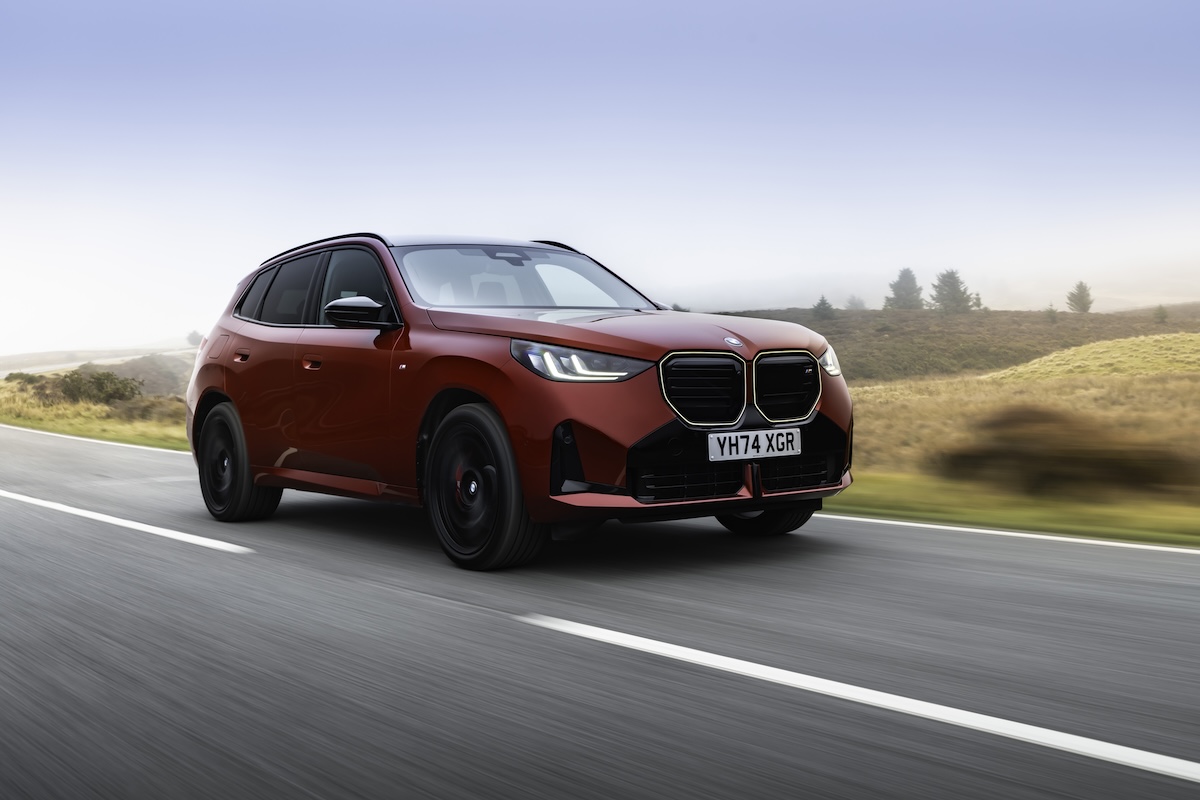
The latest fourth-generation version of the BMW X3 SUV is a logical evolution of the X3s that have come before it, the most recent of which it actually shares its basic platform with, even though that of the latest version has been heavily revised. The driving experience has the dynamism you expect of a BMW, and the interior has the practicality and (for the most part) quality that buyers will expect, while all the technology that buyers will demand is present and correct.
There are caveats. It’s not a cheap car, and you’re expected to pay even more for some key items of optional equipment that cheaper alternatives supply as standard. What’s more, we’ve only had the opportunity to drive examples riddled with optional extras - including expensive suspension upgrades - so we still don’t know how the car will feel without them. On the strength of what we’ve experienced, though, the X3 is a very appealing car.

What is the BMW X3?
The latest generation of the BMW X3 is the fourth iteration of BMW’s mid-size family SUV, and is a very important car for the brand. That’s because the German firm has sold 3.5 million of them since the original X3 was released way back in 2003, so it’s been something of a moneyspinner.
Not that you, the car buyer, should give a monkey’s about the Bavarian brand’s financial prosperity, of course. Of far more interest to you is whether you - if you’re considering a new premium-badged family SUV - should sink your hard-earned money into a new BMW X3. That’s what we’re about to find out.
The latest X3, dubbed the G45 in BMW’s internal codename speak, is actually based on the same CLAR platform as the previous third-generation X3, known internally as the G01, albeit a very heavily revised version. The car has similarly angular looks to the smaller X1, with sharp, pointy lines, and you’ll also notice the seemingly-now-obligatory huge kidney grilles on the front.
Regardless of the changes, it’s still a rival for other mid-sized premium SUVs such as the Audi Q5, Mercedes GLC, Jaguar F-Pace, Land Rover Discovery Sport, Volvo XC60, Lexus NX, Porsche Macan and Alfa Romeo Stelvio.

How practical is it?
The BMW X3 is every bit as practical as you’d want a family SUV to be. There’s a really impressive amount of legroom in the rear seats, along with generous headroom, even with the optional panoramic sunroof fitted. Tall friends and family members will be more than happy travelling in the back of an X3.
Even better, the cabin is wide enough to accommodate three sets of shoulders reasonably comfortably, while the middle seat of the rear bench isn’t as hard or as raised as they often are in such cars. That middle seat is also wider than usual as well, making it more comfortable. Whoever ends up in it will sit with their feet either side of a bulky transmission tunnel, but there’s lots of foot space for everyone so it’s not uncomfortable.
The boot space is as generous as you’d hope, too, with 570 litres (460 litres in the 30e plug-in hybrid due to the packaging of the battery pack) of square, slab-sided space on offer. There’s not much of a lip to speak of at the entrance, either, which makes it easier when loading heavy items. There’s also a bit of underfloor space for tucking small items away out of sight.
The rear seats drop down in a 40/20/40 configuration, which is more versatile than the 60/40 split in some competitors. The folded backrests sit flush with the boot floor, but they do lie at a slight angle, so there’s a gentle slope to the extended load area. More irritatingly, there are no catches to release the seats from the boot, so dropping them involves walking around to the rear door and activating the catches on the top of the rear-seat backrests.
Naturally, there’s lots of space in the front seats, plus lots of storage, too, including large door bins, a large cubby under the central armrest, and a yawningly large cubby in front of that, which combines cupholders, a wireless phone charger and more space for oddments.
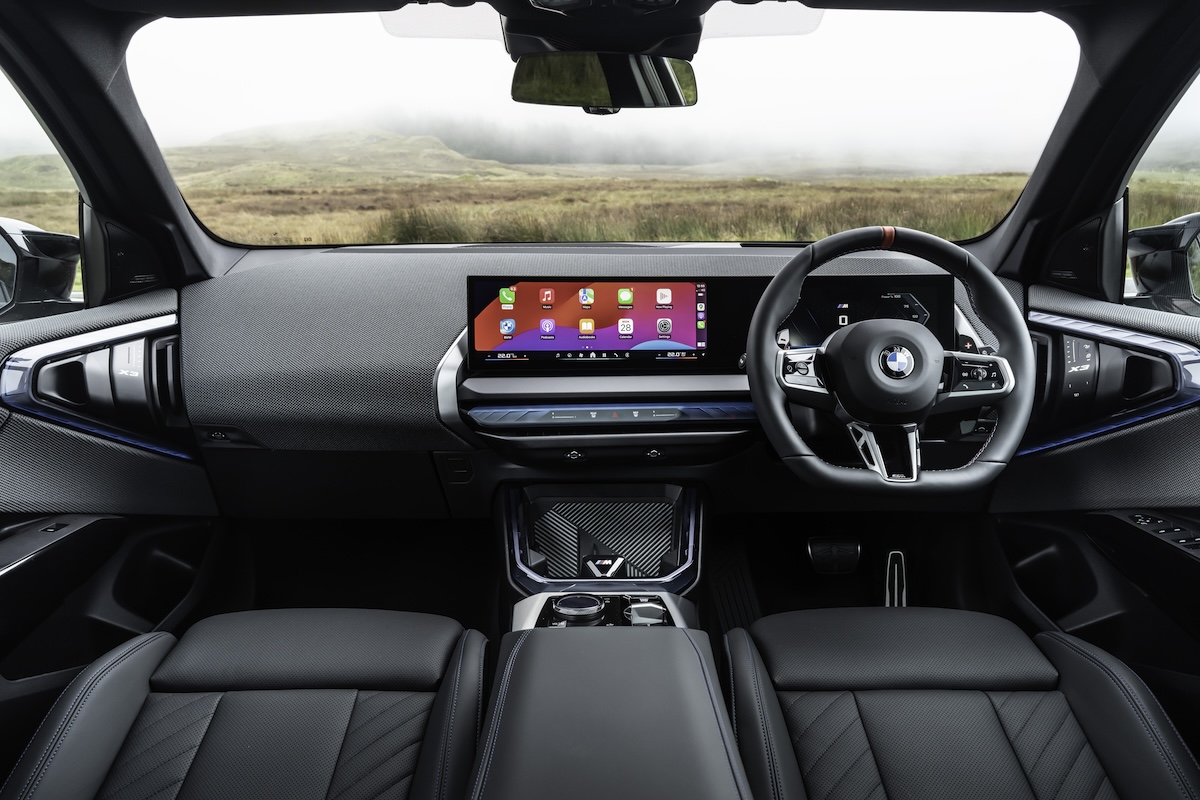
You’ll notice the same 'Interaction Bar' you get in other larger BMW models such as the 5 Series and 7 Series, which is a horizontal illuminated strip that houses a small number of touch-sensitive controls for various functions, as well as providing ambient lighting in the cabin (the whole thing glows orange when you activate the hazard lights, for example). Useful or gimmicky? You’ll decide for yourself.
You expect any BMW - especially a reasonably big one like the X3 - to have a posh feel, and to be honest, you might have slightly mixed feelings about the X3 on that score. The vegan leather upholstery and many of the trim pieces look and feel good, while the woven textile finish on the dashboard injects some style. However, there are plastics in a handful of areas - notably the door pulls, the door bins, and the panel immediately below the infotainment screen - that are surprisingly below-par in their look and feel.

What’s it like to drive?
There are four powertrain options to choose from with the X3, all of which are turbocharged and have an eight-speed automatic gearbox, along with BMW’s xDrive all-wheel-drive system. The first is the 20 petrol (which would’ve once been called the 20i, but the ‘i’ part of the old nomenclature has now been dropped). The 20 has a 2.0-litre, four-cylinder petrol engine, together with 48-volt mild hybrid assistance, to develop a total of 205bhp. The official 0-62mph sprint time stands at 7.8 seconds, and the top speed at 134mph.
The 30e, meanwhile, is a plug-in hybrid version that uses this very same petrol engine, but combines it with a much beefier motor and a far larger battery to develop a total of 295bhp. The top speed is the same, while the 0-62mph sprint time is cut to 6.2 seconds, but the biggest difference is that the 30e can travel up to 56 miles on electric power alone according to official WLTP figures.
For high-mileage drivers for whom diesel still makes sense, there’s a single option in the form of the 20d, which uses a 2.0-litre diesel engine and mild hybrid assistance to develop a total of 194bhp, giving a 0-62mph sprint time of 7.7 seconds.
At the top of the range sits the sporty X3 M50, which has a 3.0-litre six-cylinder petrol engine complete with a 48-volt mild hybrid system that delivers a stonking 393bhp. This version will surge from 0-62mph in just 4.6 seconds, and onto an electronically limited top speed of 155mph.
So far, we’ve only had the opportunity to drive the entry-level 20 petrol, and the range-topping M50. In the case of the former, the performance on offer will be entirely adequate for most drivers. It never feels underpowered or short of go, and it works smoothly and cleanly with the automatic gearbox, but by the same token, it never feels awfully fast. You often feel like the engine is having to work quite hard to shift the bulk of the X3’s body around, which results in the faint noise of the engine revving away in the background. However, the engine noise is sufficiently well isolated that this very rarely becomes a problem.
The M50 feels like almost the exact opposite. It has an immensely brawny feel right throughout the rev range: not to the point where the throttle pedal becomes difficult to modulate at low speeds, but you are aware that vicious acceleration is only ever a brief flex of your right ankle away. And once your ankle gives in to temptation, the surge of forward motion is eye-wideningly brutal. That applies both off the mark, and when you’re already going at a fair old lick, and the noise that accompanies your race towards the horizon is absolutely glorious. For the sake of your licence, you’ll really need to keep an eye on your speedo.
The X3's suspension setup depends on which version you choose and how you spec it. Both xLine and M Sport models have passive (that is to say not adaptive) suspension as standard, the latter with slightly racier settings, but we haven’t yet tried either configuration. All cars we’ve had the opportunity to drive have been fitted with optional adaptive suspension, which costs extra on both versions (although you pay around half the amount for it if you choose the M Sport over the xLine).
With adaptive suspension fitted, the X3 is a very pleasant car to drive. Select the Sportier mode and everything hunkers down and feels very taut, and this gives impressively tight body control to accompany the strong grip and super-sharp steering responses that make the car feel satisfyingly pointy. However, while some drivers will love this firmness, others will probably find it to be a bit too much. No matter, though: select the more comfort-orientated suspension setting, and that firmness is dialled back by quite a lot, to the point where the ride is still a little on the firm side, but will be easily forgiving enough for most. Bumps and potholes won’t have you wincing any more, that’s for sure.
Technology, equipment & infotainment
As with BMW’s other recent models, the X3 comes with a pair of high definition digital screens mounted on the dashboard, both of which are integrated into one unit that curves gently around the driver. The 12.3-inch screen behind the steering wheels serves as the driving instruments, while the 14.9-inch one that sits more towards the centre of the dashboard deals with the infotainment functionality. It all looks great, with sharp-colourful graphics, fast-moving screen transitions and glossy finishes to the screens.
Yes, the now-obligatory touchscreen functionality is present and correct, but importantly, so is the rotary controller that has for so long been part of BMW’s iDrive infotainment setup, plus a handful of very useful shortcut buttons. This all makes scrolling through on-screen menus and between icons much less distracting than jabbing and swiping at them with your finger as you drive along, which we think has large benefits when it comes to safety. And while the complexity of the system and the sheer amount of features it controls can be slightly bamboozling at times, it’s actually a bit easier to find your way around than most.
The infotainment system alsi supports all the usual stuff like navigation, DAB radio, Bluetooth, wireless phone charging, four USB-C ports, Apple CarPlay and Android Auto, and it’s all standard on all versions of the X3.
There are two main trim levels in the X3 line-up. The entry-level one is called xLine, and on top of all the infotainment gubbins, you also get LED lights all round, alloy wheels, power folding door mirrors, a powered tailgate, three-zone climate control, recycled cloth upholstery, electrically adjustable front sports seats with heating, a leather sports steering wheel, cruise control, parking sensors and a reversing camera.
M Sport trim adds all sorts of racy styling additions, vegan leather upholstery, and M Sport suspension. The M50 version, meanwhile, comes in its own standalone trim level that not only gets a shedload of extra power, but also an illuminated grille, quad exhausts, M Sport brakes and some glitzier interior finishes.

BMW X4 running costs
Prices for brand new versions of the 20 petrol and 20d diesel start at around the £50,000 mark, while the 30e PHEV version starts at more like £60,000, and the range-topping M50 more like £70,000. As per usual, BMW offers no shortage of optional extras - many of them bundled up into expensive packs - that’ll allow you to propel the price of your car even further into the stratosphere, if you so wish.
Very predictably, it’ll be the high-performance M50 version that’ll cost you most in fuel. Official WLTP figures put its fuel economy at up to 36.7mpg, but if you drive it like the bods at BMW’s M Division intended, then you’ll be down into the teens in no time at all.
The next thirstiest is the entry-level 20 petrol, with an eminently reasonable return of up to 40.9mpg, while the 20d diesel gets the figure up to 48.7mpg.
On paper, the 30e plug-in hybrid is the best of the bunch on fuel consumption, and by some distance. Official figures put its average at up to 313.9mpg, thanks to its ability to run for up to 56 miles (another WLTP figure) on electric-only power. Super-low official figures for CO2 emissions will also make this the best choice for company car drivers, because they put the PHEV in a very low banding for Benefit-in-Kind tax bills, although not the lowest available to PHEVs (such cars with an all-electric range of 70 miles or more pay even less).
Like always, though, the official fuel economy figure of the 30e should be treated with a fair amount of scepticism, because the official WLTP tests are, by their nature, unrealistically flattering to plug-in hybrids. The return you actually get in the real world will depend entirely on how you use the car. Keep it topped up with electricity and limit yourself exclusively to short journeys that can be completed using just the electric motor, and you won’t use a drop of petrol. However, as soon as that petrol engine fires into life, then it probably won’t be a great deal more efficient than the M50 range-topper, and that’ll bring your average down very quickly. Do the unthinkable, and simply never bother charging it, and it’ll become a very costly car to run indeed.

BMW X3 reliability
In the 2024 What Car? Reliability Survey, BMW finished 8th overall in the manufacturer standings, which included 31 carmakers, a vast improvement on the performance of previous years. That also puts it a long way ahead of almost all other premium manufacturers, with the exception of Lexus, which came in second place overall. And the brand that topped the study? That would be MINI, which as you probably know, is owned and operated by BMW.
Things haven’t looked quite so rosy for the X3 itself. In the Large SUV class of the study, the diesel-powered X3 came in 13th place out of 24 models considered, with 19% of owners’ cars going wrong, while the petrol X3 came in 17th, with a failure rate of 29%. The satnav and infotainment system accounted for many of the faults, along with various other electrical components.
Granted, this result does apply to the previous version of the X3 rather than the shiny new one we’re talking about here. However, it’s also true that the two cars share a platform and many parts, albeit in heavily revised forms, so it’s not impossible that some problems might be inherited. However, we’d hope that the overhaul might result in some improvements given BMW’s recent reliability renaissance, not least because the previous car’s troublesome infotainment has been replaced by BMW’s latest OS9 system.
BMW’s warranty package is a three-year, unlimited-mileage arrangement: that’s no great shakes in terms of time period compared with the warranties provided by some manufacturers, but in fairness, the mileage limit - or rather, lack of one - is a lot better than average.
- The BMW X3 is supplied as standard with semi-autonomous driving aids including front collision warning, automatic emergency braking, lane departure warning, speed limit info, lane change warning and speed limit assist.
- The options list contains more safety measures. These include a steering and lane control assistant, automatic speed limit assist, and active cruise control. It’s a bit rubbish that that last item isn’t standard-fit on the X3 when it is on many smaller cars costing a fraction of the price.
- The X3 reviewed here isn't available as a fully electric car. For that, BMW offers a separate model, the iX3, which can travel up to 285 miles on a full charge. The iX3 is an impressive EV, and although it shares its design with the previous generation of X3, it still looks and feels very upmarket.
- For those on a budget: If you’re considering a car as expensive and as aspirational as the X3, then it’s unlikely that your budget will be massively tight, but if you must have the Beemer and want to spend as little as possible on it, then you want the 20 petrol version, which is the cheapest on offer. Performance and economy are adequate, too.
- For company car drivers: The low CO2 (official) emissions of the 30e plug-in hybrid mean that you’ll pay way less in Benefit-in-Kind company car tax on this version than you will on any other X3. The differences are massive, too.
- For long-distance drivers: The 30e PHEV’s official WLTP fuel economy might be huge, but that type of powertrain works best over short distances. If you’re constantly pummeling the UK’s motorway network, then the 20d diesel will be the X3 that suits you best, however unfashionable it may be.
- For speed demons: The M50 is massively fast, it sounds fantastic, and it handles brilliantly, so it’s an utterly intoxicating driving experience. For someone who wants a car that blends fun with functionality, it’s difficult to beat.

