Volkswagen T-Cross Review (2019-present)
Volkswagen T-Cross cars for sale
4.0
Expert review
Pros
Easy to drive
Funky SUV styling
Practical cabin
Cons
Many rival compact crossovers are cheaper to buy
VW's new-car warranty is no match for Kia or Hyundai
Disappointing interior quality on early examples

The CarGurus verdict
The Volkswagen T-Cross is one of the better cars in the small SUV class, a class that’s packed with talent. It looks smart, it’s good to drive, it’s well equipped, it has reasonable cabin space and it has a really flexible and versatile cabin. Running costs are reasonable, too, which makes it even more suitable for a small family.
Yes, the Ford Puma is more fun to drive, the Skoda Kamiq is roomier, and the cabin finish in earlier examples is a bit disappointing, although that was made better during the 2024 facelift. It’s not the cheapest SUV of its type, either. Those slight misgivings aside, the T-Cross is a car that will do everything a small family needs it to.
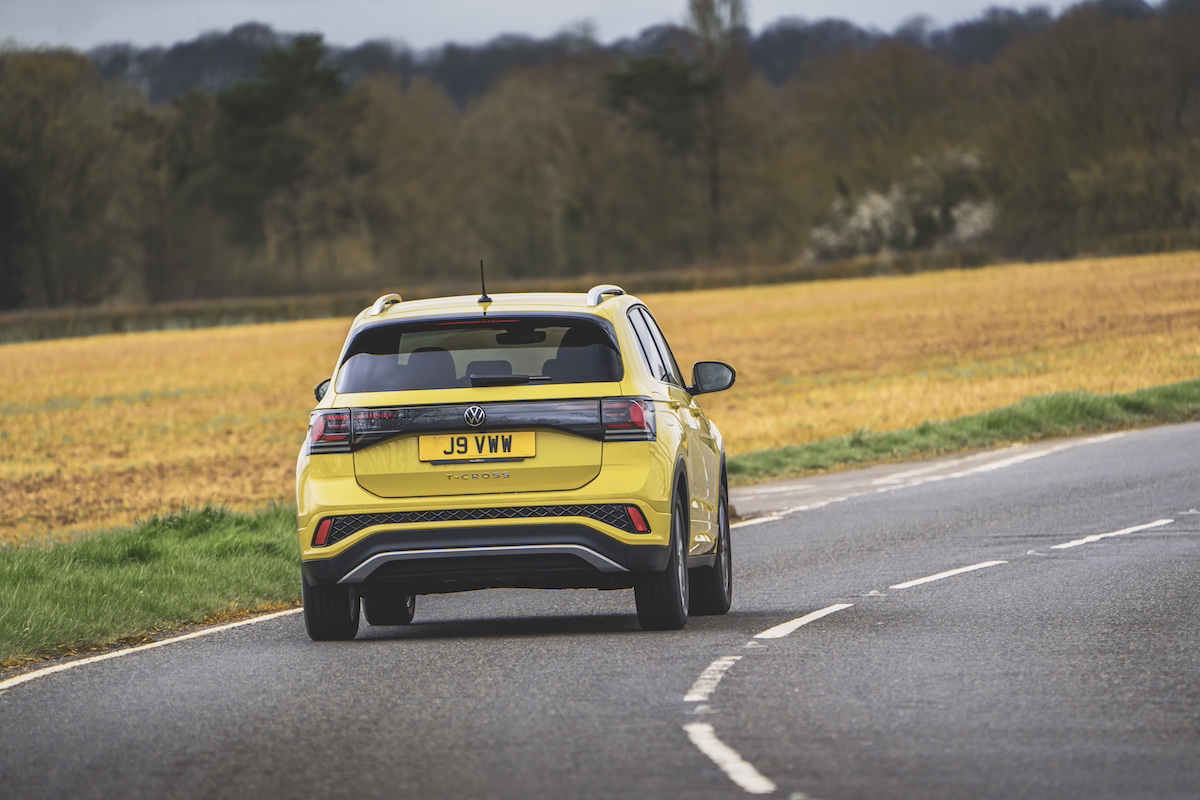
What is the Volkswagen T-Cross?
SUVs are immensely popular right now, and that’s why Volkswagen makes A LOT of them. So many, in fact, that it’s easy to get confused between them. For instance the Volkswagen T-Cross we’re reviewing here and its T-Roc sibling are very similar in size, with the T-Roc being slightly bigger and more expensive. However, the T-Cross comes with some clever features that the T-Roc doesn’t, and that arguably makes it the cannier purchase.
Rivals for the T-Cross are many, but include the Nissan Juke, Suzuki Vitara, Ford Puma, Vauxhall Crossland, Peugeot 2008, Renault Captur and plenty more besides. The T-Cross was first released in 2019, and was given an extensive facelift in 2024 to keep it fresh and competitive.

How practical is it?
We mentioned a moment ago that the T-Cross has some clever features that the T-Roc doesn’t, and the most important of them is a sliding rear bench seat that makes the car way more practical and more versatile. It allows you to trade a bit of rear legroom for extra boot space, and vice-versa. With the rear seats all the way back, there's 385 litres of boot space, which is more than you'd find in a VW Golf. Pull them forwards by 14cm and luggage space increases to 455 litres. Rear legroom isn't especially generous, though - there’s plenty with the seats all the way back, but things get rather tight if you pull them all the way forward - so this feature would be even more worthwhile if there was a bit more room to start with. Of course, those up front get plenty of space.
It’s fair to say that the interior quality of early T-Crosses was a little disappointing. There were way too many hard and shiny plastic panels on display, so the standard of finish was well below what you'd expect from VW, especially given that the car costs more than many of its rivals. Volkswagen took steps to remedy this during the 2024 facelift, and introduced plusher materials as part of an extensive interior redesign. It really did the trick, with the T-Cross finally having the high-quality feel it always should have had.
Another aspect of the interior redesign was rather less appealing: the pre-facelift car’s physical buttons and dials for controlling the climate control were replaced by a touch-sensitive panel with icons and slider controls. These are far less easy - and as a result, more distracting - to use on the move, but at least it’s better than incorporating the ventilation controls within the menus of the infotainment touchscreen system, which VW seems obsessed with doing in many of its other cars at the moment.

What’s it like to drive?
Under the skin, the T-Cross is closely related to the Polo supermini. That's no bad thing, as the Polo is one of the safest and most comfortable small cars. The T-Cross's engines will also be familiar to anyone who has driven a Polo.
The entry-level engine is a 1.0-litre TSI turbocharged three-cylinder petrol with 94bhp. It's livelier than you might expect, and should be affordable to run as well as to buy.
There’s also a more powerful version of the same engine, which had either 108bhp or 113bhp depending on when your car was built (it changed back and forth as VW worked to make it comply with changing emissions regulations). Either way, it adds an extra slice of brawn to the performance that the entry-level engine gives you, and it’s more at home in more driving situations, so it’s the one we recommend. Whereas the entry-level engine is always matched to a five-speed manual gearbox, the more powerful 1.0-litre petrols are offered with a six-speed manual or a seven-speed DSG automatic. Both are good.
The most powerful petrol is a 148bhp 1.5-litre TSI. There's a noticeable step-up in performance with this engine, and it's a good choice if you want the car to still have some performance in reserve on the motorway. This engine is only available with the DSG 'box.
Early on, buyers also had the choice of a 94bhp 1.6-litre TDI diesel engine, paired with either a five-speed manual gearbox or a seven-speed auto. It was the most fuel-efficient model in the range, but not as smooth and refined as the TSI petrols. It was later phased out as diesel became less and less popular with buyers.
Whichever engine is fitted, the T-Cross drives really well. It’s one of the more comfortable cars in its class, with an absorbent ride and well controlled body movements. The ride becomes a little less forgiving on the large 18-inch wheels of early R-Line models, so we’d swerve those, but it’s still a comfy car. Whatever your trim level and wheel size, the car handles neatly: it's not as much fun as a Ford Puma, but it changes direction in a tidy, precise and secure way.
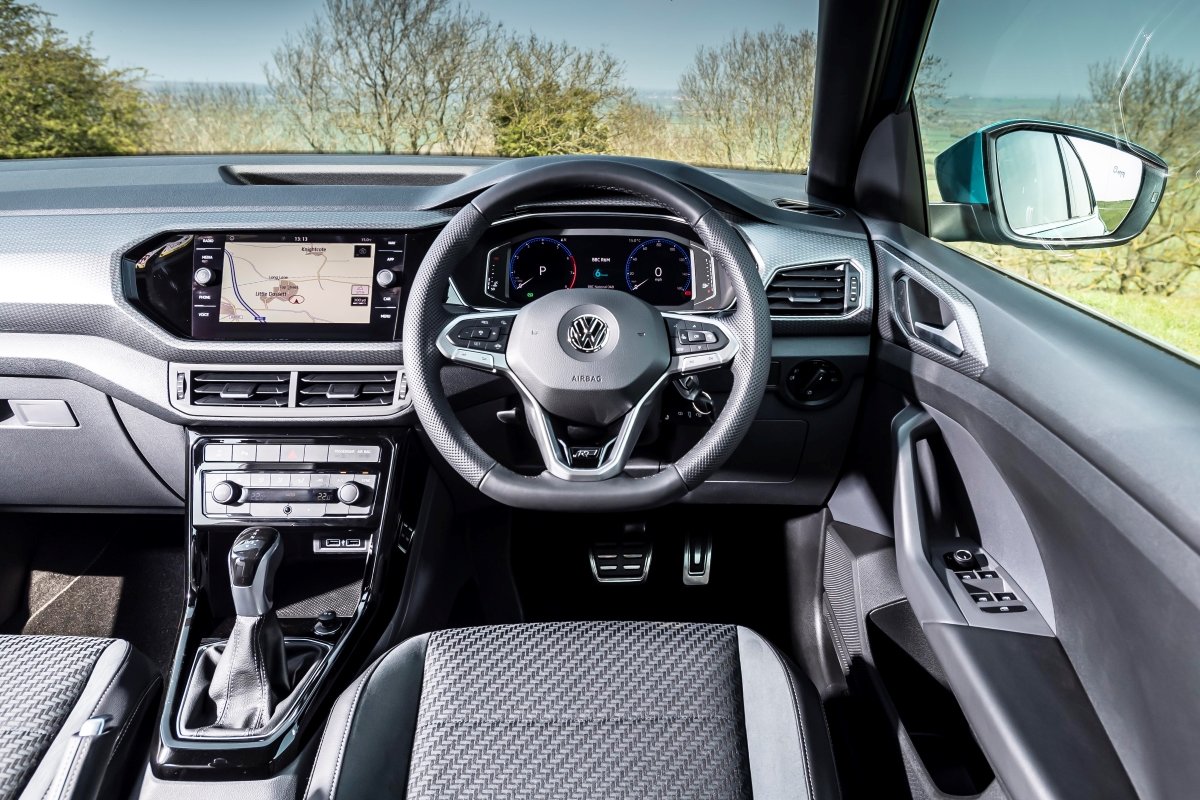
Technology, equipment & infotainment
Early on in the T-Cross’ life, the range started with the S trim level. This came with 16-inch alloy wheels, an eight-inch touchscreen, Bluetooth connectivity, and manual air conditioning. SE spec added 17-inch alloys, adaptive cruise control, a variable height boot floor, and compatibility with Apple CarPlay and Android Auto. United spec gave you Atlantic Blue decorative inserts in the dash, heated front seats, front and rear parking sensors, and voice activation for the in-car entertainment system. SEL upgrades included satellite navigation and climate control in place of basic air conditioning. R Line models had 18-inch alloys, sports seats, a leather-trimmed three-spoke steering wheel, a fully digital cockpit and sportier looks than the rest of the range.
There were also various special edition models offered throughout the car’s life, which offered extra kit for a knock-down price.
The trim levels changed completely during the 2024 facelift. Life is now the entry-level trim, and this comes with 16-inch alloy wheels, black roof rails, LED headlights and rear lights, leather multifunction steering wheel, moveable boot floor, four electric windows, power folding door mirrors, automatic lights and wipers, manual air conditioning, front- and rear parking sensors, and adaptive cruise control. The standard infotainment system is based around an 8.0-inch touchscreen freestanding touchscreen (rather than the dashboard-integrated unit in the pre-facelift car), and has DAB with six speakers, Bluetooth and wireless Apple CarPlay and Android Auto.
Match trim adds 17-inch wheels, keyless entry and go, rear privacy glass and a rear-view camera. Style trim adds silver roof rails and climate control, while in-built nav and internet are added to the infotainment system. R-Line trim trades what Style trim gives you for 17-inch wheels, added exterior styling touches, sports seats, ambient lighting and a larger 10.25-inch screen for the infotainment system.
Whichever infotainment system your car has, it’s a sight less complicated - and therefore much easier to use - than the systems in some of Volkswagen’s more recent models, and handy shortcut buttons either side of the screen help this useability further.
Safety kit is generous across the board. Driver, passenger, front side, and front and rear curtain airbags are fitted to every model. An autonomous emergency braking system is also standard – VW calls it City Emergency Braking - and it can detect pedestrians as well as other vehicles. All that has helped the car score the maximum five-star rating in Euro NCAP crash tests. Post-facelift cars also have adaptive cruise control and a suite of semi-autonomous driver aids as standard.

Volkswagen T-Cross running costs
The T-Cross isn't the cheapest compact crossover to buy - it's undercut by the Skoda Kamiq, for example - but it's up with the best cars in class for running costs, despite not having a hybrid version.
For the lowest fuel bills, pick the 1.6-litre turbodiesel. It returns up to 54mpg with a five-speed manual, and up to 52mpg with the automatic gearbox.
The three petrol engines are all quite closely matched in terms of economy and emissions. The least powerful 94bhp 1.0-litre TSI gives you 49mpg, which is actually marginally less than the 50mpg of the more powerful version: that’s because it has to work a bit harder to maintain equivalent pace. That drops to 49mpg with the automatic gearbox, while the 1.5 TSI isn’t far behind on 47mpg.
Volkswagen offers a choice of fixed and flexible service intervals. Fixed servicing requires the car to go up on a ramp once a year or every 10,000 miles, whichever comes first. VW recommends fixed servicing intervals for low-mileage drivers (fewer than 10,000 miles per year). If the T-Cross is set for flexible intervals, sensors in the car determine when a service is needed. This option is recommended for high-mileage drivers.

Volkswagen T-Cross reliability
Volkswagen’s reputation for reliability isn’t always justified, and that’s backed up by hard data. In the 2023 What Car? Reliability Survey, the brand came 22nd out of the 32 considered in the study, which is hardly dreadful, but it’s hardly dazzling, either. The T-Cross itself fared quite well, however. It placed 8th in the Small SUV category out of 22 cars considered.
The T-Cross has been subject to a recall, though. The joint on the discharge nozzle for the curtain airbag's gas generator may have been poorly welded. This can cause the joint to fail when the airbag is triggered, impairing the proper inflation of the airbag and increasing the risk of injury. Affected cars were made between 20 May 2019 and 21 June 2019.
You can check if any VW T-Cross you are thinking of buying has any recall work outstanding by contacting a Volkswagen dealer. Alternatively, just enter the registration number into the recall checker on the gov.uk website.
Every brand new VW T-Cross comes with a three-year/60,000-mile warranty (the first two years are manufacturer operated with no mileage car, while the third year is dealer operated and applies the 60,000-mile cap). It can be extended at extra cost. If you'd prefer a longer standard warranty, consider the Hyundai Kona with its five-year/unlimited-mileage cover, or the Kia Stonic with a seven-year/100,000-mile policy.
- You'd expect the most powerful petrol model to be considerably thirstier than the rest of the range, but the 1.5-litre TSI actually returns some impressive mpg figures. It has a trick up its sleeve in the form of Active Cylinder Technology. This allows the four-cylinder engine to switch to two-cylinder running under light loads. This cuts fuel consumption and reduces emissions. Switching from four- to two-cylinder running takes between 13 and 36 milliseconds, VW claims. You'd be hard-pressed to notice from the driver's seat if it wasn't for a light that comes on between the speedometer and the rev counter.
- The T-Cross sells outside of Europe, but under other names. Buy one in China, and it’ll be called the Tacqua, while in India, the car is known as the Taigan. Which is confusingly close to the Taigo that’s also offered here, and is a version of the T-Cross with a more streamlined coupe-like roof.
- The top-spec Discover Media Navigation infotainment system comes prepared for a suite of online services, which VW calls We Connect Plus. This allows for online traffic information, over-air map updates, internet radio, online streaming services and more. Through a compatible smartphone, We Connect Plus also allows owners to set the air conditioning to bring the cabin to a comfortable temperature before going to the car, or to lock and unlock their T-Cross remotely. The Discover Media Navigation system is standard on the Style and R-Line.
- If you cover lots of motorway miles: Go for an early 1.6 TDI diesel. It's not the smoothest or most refined engine in the range, and diesel may now be out of favour with most buyers. However, for fuel economy, especially on a long motorway drive, diesel is still hard to beat.
- If you are on a budget: Pick the 94bhp 1.0 TSI in entry-level S or Life trim, depending on age. It's comfortably the most affordable version of the T-Cross, and it will be cheap to fuel and insure, too. You still get the clever sliding rear bench and the handsome looks, and the S-spec car rides more comfortably than the more expensive trim levels with larger alloy wheels.
- If you want the best all-rounder: Go for the 1.0 TSI engine in the higher state of tune. The more powerful of the two 1.0-litre turbocharged petrols offers that bit more pep, and with six gears rather than five, it's quieter on the motorway.
- If you want a sporty T-Cross: Choose the 1.5 TSI Evo. There's more mid-range pull as well as top-end power if you pick this engine. It's no hot crossover, but there's enough pep to the engine to make the most of the VW's able handling.


