Volkswagen T-Roc 2017-2025 review | A dependable and stylish small SUV
Volkswagen T-Roc cars for sale
4.0
Expert review
Pros
Roomy boot on front-wheel-drive models
Comfortable ride
Engaging handling
Cons
Lacklustre interior quality on pre-facelift cars
Rear seats lack flexibility
Reduced boot space in 4Motion models
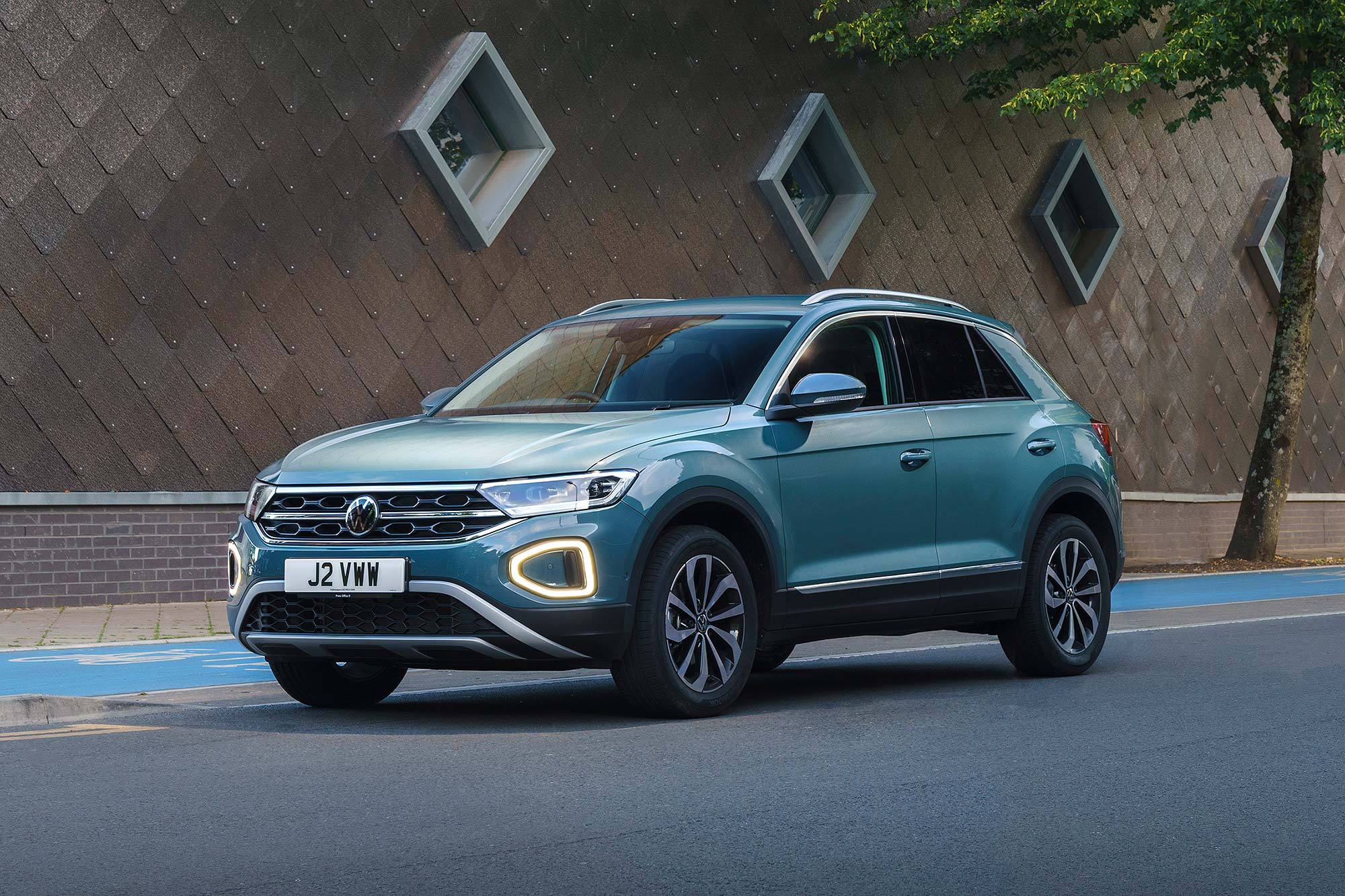
The CarGurus verdict
The Volkswagen T-Roc is one of the most solid small SUVs you can buy. Its cabin is roomy, its ride is comfortable and all trim levels are reasonably well equipped. The engines strike a good balance between performance and economy, and the T-Roc is satisfying to drive.
We reckon the SE specification on early cars, or the Style on later cars, offers the best value for money. The higher spec models are tempting, but considerably more expensive.
The biggest disappointment is the interior finish in pre-facelift cars. Like the smaller Volkswagen T-Cross, a used T-Roc can look disappointingly cheap inside, with lots of unappealing hard plastics. If you want more interior space and practicality, a Skoda Karoq offers more room for passengers and luggage for a similar price. And if you can manage with a little less space, the Ford Puma is a more rewarding car to drive. As an all-rounder, though, the T-Roc is close to the top of the small SUV class – and certainly worth adding to your shortlist.

What is the Volkswagen T-Roc?
The VW T-Roc went on sale in 2017, catering for the public’s ever-expanding appetite for compact SUVs. Sitting between the smaller T-Cross and larger Tiguan in the VW range, the T-Roc was well received at launch. There was nothing particularly innovative or flashy about it, but it went about its business confidently, much the same way the Golf has in the hatchback world for several decades.
Its mid-life refresh in 2022 saw a raft of updates, with small revisions to the exterior styling, an updated interior and a new trim line-up. Then in August 2025, VW unveiled the second-generation T-Roc, meaning the end of the road for the first-gen car you see here. It went out on a high, though, becoming the second most popular Volkswagen SUV ever made (behind the Tiguan).
Rivals for the T-Roc include a countless number of midsize SUVs, including the Nissan Qashqai, Volvo XC40, Skoda Karoq, Peugeot 2008 and Hyundai Kona.

How practical is it?
The T-Roc has a boot capacity of 445 litres, almost a match for the Mini Countryman's 450 litres and usefully more than the Audi Q2's 405 litres. Additionally, the adjustable-height boot floor (available on front-wheel-drive models) can be lowered to create usefully more space than you'd get in a Golf hatchback. Specifically, 17 per cent more space, if you’re interested.
Boot space drops to 392 litres for the all-wheel-drive 4Motion models, though, and although the rear bench splits and folds 60:40, it doesn't slide back and forth on runners like the back seats in the cheaper VW T-Cross.
The cabin is roomy in the front and rear seats, with plentiful legroom and lots of headroom (provided you haven't opted for the panoramic sunroof). Note, however, that the large transmission tunnel and narrow middle seat will make it a squeeze to fit three adults across the back. For short journeys, it’ll be fine, but on longer trips it would prove a bit of a pain for whoever drew the short straw.
The T-Roc’s driving position is spot on, with plenty of steering wheel and seat adjustment to suit drivers of different shapes and sizes. In earlier models, the cabin plastics were not as polished as you’d have found in a Golf, but VW addressed this for the 2022 facelift with the addition of a soft-touch panel across the top of the dashboard.
While the T-Roc is unusual for being available as a Cabriolet, that model only has four seats. Sure, the drop-top is a bonus if that’s what you’re looking for in this class (you won’t find a convertible Nissan Qashqai or Skoda Karoq unless it’s had a date with a rotary saw), but there are plenty of other drawbacks to the convertible beyond its reduction in seating capacity.

What’s it like to drive?
One of the T-Roc’s standout qualities is its comfortable ride. It copes really well with uneven road surfaces. However, if you choose what was one of the pricier, higher-spec models, these come with larger 17- or 18-inch alloy wheels rather than the standard 16-inchers, so you feel bumps in the road that bit more. Find a car with 17-inch ‘Hot Orange’ diamond-turned wheels and you can give yourself a pat on the back, as we suspect there were very few people who ticked that particular option box.
On cars with the optional Dynamic Chassis Control, which includes adaptive dampers, you can choose between different settings to make the car feel smoother or more sporty. Switching between Normal, Comfort and Sport modes, you will also notice changes to the steering weight and throttle response. DCC wasn’t a cheap extra, costing around £1,000 depending on the trim level when new, but on a used car it’ll be a very welcome addition.
The flipside to relatively soft suspension is more body-roll when you turn into a corner than you’d experience in some rivals – the Seat Ateca, for example. However, the T-Roc handles neatly and we think VW has got the comfort and agility balance just about right. One final point to note on the subject of ride and handling is that the T-Roc was available, or came as standard, with sports suspension, depending on the model chosen. This reduced the ride height by 20mm and brought with it ‘progressive steering’, which essentially makes the steering lighter and less pointy at low speeds, then heavier and more direct as you go faster.
There was a large engine range for the T-Roc throughout the duration of its life, and we can’t cover every one in detail here. Suffice to say you’re going to be well catered for, whether you want a petrol or a diesel.
The entry-level 1.0-litre, three-cylinder turbocharged petrol engine had 113bhp at launch, but was later replaced by a 108bhp engine that met the tougher RDE2 emissions standard. For a bit more poke, there's a 148bhp 1.5-litre TSI Evo petrol engine. This is noticeably quicker than the 1.0-litre petrol, and would be our recommendation if your budget allows.
If you want a small SUV with GTI-style performance, you can go for the more powerful 187bhp 2.0 TSI. This version uses VW's 4Motion all-wheel-drive system to make the most of its extra power, even on slippery roads.
If performance is top of your wishlist then, of course, there’s the 296bhp Volkswagen T-Roc R, which is in a different league entirely. This all-wheel-drive performance SUV is a capable rival to the Audi SQ2 and Cupra Ateca, but a similarly powerful Volkswagen Golf R is cheaper and more fun.
Diesel-engined T-Rocs are generally a lot slower, but could make for a sensible buy for high-mileage drivers. The entry-level 113bhp unit’s performance is fairly pedestrian, while the TDI engine is noisier than the TSI petrols. However, it's incredibly economical. There's also a 148bhp 2.0-litre TDI, which trades a little fuel economy for much stronger performance.
Find a T-Roc Cabriolet and you’ll have to do without diesel power. This model offers a choice between the higher-powered 1.0-litre TSI and 1.5 TSI petrol engines.
Whichever engine you think you want, keep in mind some were only available with certain trim levels. You wouldn’t be able to get a 113bhp petrol with an R-Line car, for example, as the performance wouldn’t match up with the sportier spec of the rest of the car.
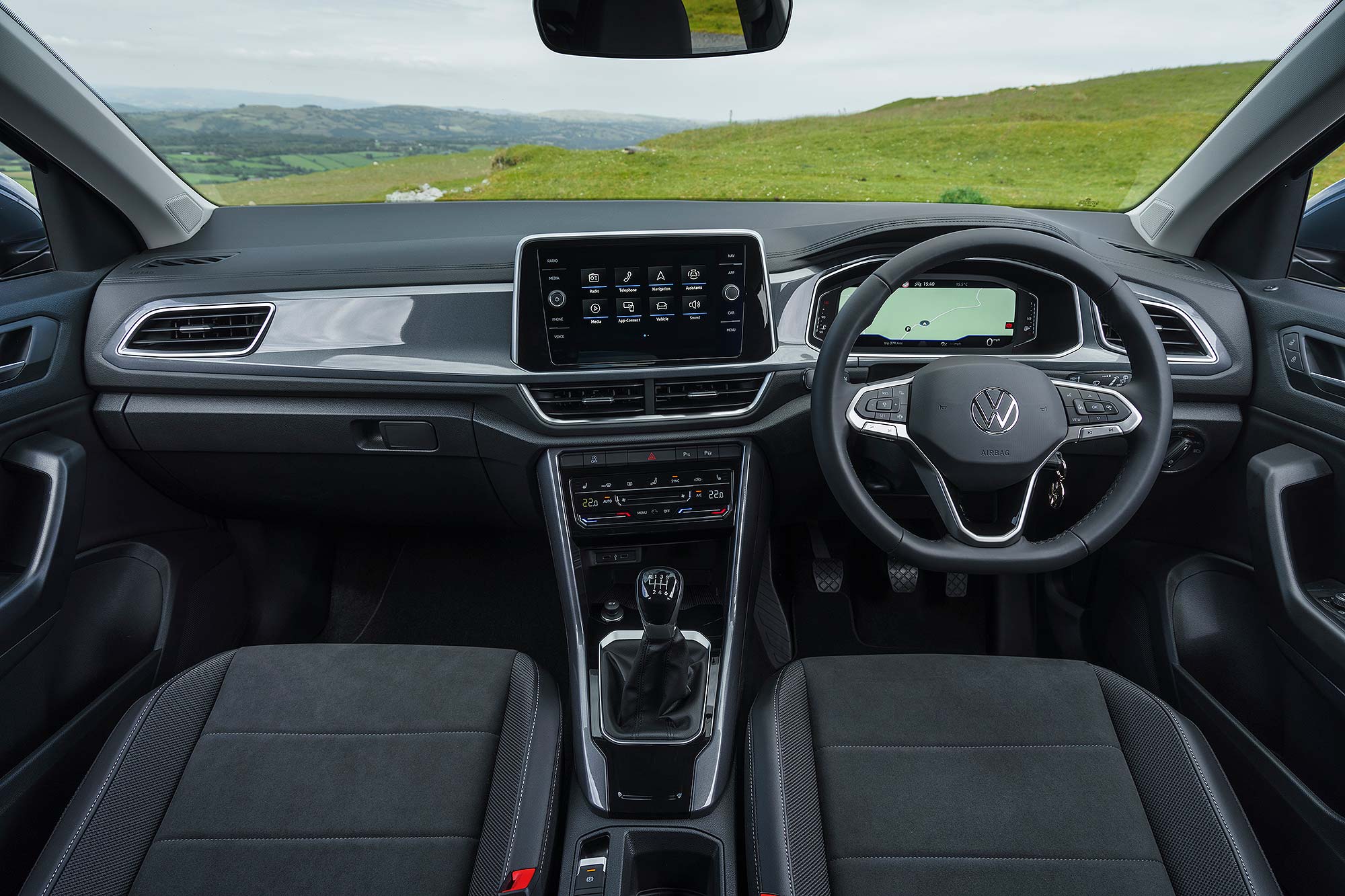
Technology, equipment and infotainment
At launch, T-Roc trim levels started with the the S, thn climbed upwards through SE, United, Black Edition, Design, SEL, R-Line and R. Entry-level cars came with 16-inch alloy wheels, an 8.0-inch touchscreen infotainment system, climate control air conditioning, front and rear electric windows, and a DAB radio. There's a decent roster of kit, in other words, without having to upgrade to one of the more expensive specifications.
As of the 2022 facelift, the trim line-up was simplified. It kicks off with the entry-level Life model, while buyers wanting more equipment (including the larger digital dial display) can choose either the Style trim as more of a luxury option, or the R-Line trim for a sportier-looking T-Roc. It’s worth noting a digital instrument display measuring 10.3 inches was optional on pre-facelift cars but standard after the facelift (albeit measuring either 8.0 or 10.3 inches). In both cases, it was known as the Active Info Display.
The technology onboard the T-Roc mirrors what you’ll find in contemporary VWs. That largely means it’s thoughtfully presented and easy to use, although in our experience the touchscreen infotainment in facelift models isn’t as intuitive to use as the setup in earlier T-Rocs.
Later cars also benefitted from the ‘IQ. Drive Travel Assist’ package, effectively bundling together existing and new assisted driving systems. This can control the steering, brakes and throttle from low speeds (0mph in automatic cars and 19mph in manual cars), right up to the car’s maximum speed. It can be activated using the Travel Assist button on the steering wheel, but you still need to keep your hands on the wheel and be in control of the vehicle.
The 2022 facelift also saw the introduction of predictive cruise control, which read the road ahead, combining this data with navigation and traffic information to provide a more holistic view of your journey time, any potential hazards, and so on.

Volkswagen T-Roc running costs
As we've mentioned, the diesels are the picks of the range if you want low fuel bills. The 113bhp 1.6-litre TDI returns up to 54.3mpg on the combined cycle. The 148bhp 2.0-litre diesel is only a little less economical, with a combined figure of up to 53.3mpg with a six-speed manual gearbox (or 51.4mpg with the automatic). In real-world driving, any of the diesels should return 50mpg or so unless you have a heavy right foot.
The TSI is economical by petrol engine standards. Reckon on close to 50mpg from the 1.0-litre version, and 40-45mpg from the 1.5. Manual cars will be slightly more economical than those with a DSG automatic gearbox.
You won't be able to match that economy with the more powerful 187bhp 2.0-litre TSI. Its combination of more power, all-wheel drive and an automatic ’box mean 35-40mpg is more likely. Go for the high-performance R version, and you can expect mpg in the mid to low 30s, depending on how hard you drive it.
The R will be by far the most expensive T-Roc to tax, because the list price was on the wrong side of £40,000. This means it attracts an annual car tax surcharge in years two to six. The R will also hit your bank balance hardest when it comes to insurance. It sits in group 34 of 50, while the rest of the range varies from group 10 to 24. That's broadly in line with most rivals; in fact, it exactly matches the group 10 to 24 spread of the Seat Ateca.
If you want to keep a lid on servicing bills, Volkswagen offers servicing plans that fix the cost and allow you to pay up front or monthly. However, Volkswagen is well served by independent specialists, often staffed by mechanics who used to work in franchised dealers, and these will usually undercut main dealer prices by a considerable margin.
Note that no T-Roc is available with any kind of hybrid or electrified technology.

Volkswagen T-Roc reliability
Volkswagen tends to sit mid-table in reliability and owner satisfaction surveys. We wouldn't expect the T-Roc to be as trouble-free as something like a Toyota C-HR, but nor would we anticipate a litany of problems.
Some owners have experienced jerkiness when pulling away in T-Rocs fitted with the 1.5-litre TSI petrol engine. A software update should fix the issue, but not all owners are completely happy with the car, even after the update.
The T-Roc came second in its (small SUV) class in the What Car? Reliability Survey for 2025, behind only the much newer and fully electric Kia EV3. That’s very good news indeed, especially when the wider VW brand overall occupies joint 24th spot (with Ford) out of a total of 30 manufacturers.
There are some recalls to be aware of. One concerns the fitting for the head restraints, which may have been incorrectly welded to the bracket, making the restraint less effective in an accident. Cars affected by this fault were made between May and August 2018.
Another recall relates to the adhesive bond between the upper and lower parts of the rear spoiler. An incorrect adhesive was used, which can lead to the upper part of the spoiler dropping off. Affected cars were made between 29 January 2018 and 12 June 2018.
Any Volkswagen dealer should be able to confirm if a car you are thinking of buying has recall work outstanding, or you can check for yourself using the recall checker on the Gov.uk website.
The T-Roc had a three-year/60,000-mile warranty, so a used example may still be within that window. But be aware that plenty of similarly sized cars come with longer warranties, with Hyundai offering a five-year warranty, for instance, and Kia a seven-year warranty on every model.
- The T-Roc is a very safe car. The experts at Euro NCAP gave it a five-star rating, including a 96 per cent score for adult occupant protection. Even entry-level cars have autonomous emergency braking, with sensors that are able to detect pedestrians as well as other cars. Driver, passenger, front-side and curtain airbags are all standard. So are Isofix mounting points to securely fit child seats to the two outer rear seats.
- It's not uncommon for compact SUVs to be front-wheel drive, despite their shrunken off-roader appearance. Most T-Roc models send power to their front wheels, but the 187bhp 2.0 TSI and the 296bhp T-Roc R use Volkswagen's 4Motion all-wheel-drive system. Sensors monitor each wheel, and send power to the tyres with most grip. In normal driving, 90 per cent of the engine's power goes to the front wheels, and 10 per cent to the rear, all in the name of greater fuel efficiency. In extreme conditions, though, up to 100 per cent of the engine's power can be sent rearwards. Off-road performance is unlikely to be a priority for T-Roc buyers, but if you do head off the beaten track relatively often, or want a little more reassurance in the winter months, the 4Motion system will certainly help.
- To be pedantic, the T-Roc's automatic gearbox is a mechatronic dual-clutch transmission. The seven-speed DSG (Direct Shift Gearbox) is effectively two gearboxes in one. A control unit uses information such as engine speed, road speed, accelerator position and driving mode to select the ideal gear and determine when to shift. It can pre-select the next gear while accelerating or slowing down, so each change takes less than four-hundredths of a second.
- If you want performance: Choose the T-Roc R. The combination of a 296bhp engine and all-wheel drive makes this a seriously rapid all-weather express. It carries its weight a little higher than a true hot hatchback, such as the Golf R, but it still handles with great poise and agility. The downside is the R's high price and running costs.
- If you want the best all-rounder: Pick a car with the later 1.0-litre 108bhp petrol engine. It may be the entry-level T-Roc, but it performs well and achieves impressive economy, with a claimed 47.1mpg. Also, aim for a mid-level trim, like the SE on earlier cars or Style on post-facelift examples. You’ll likely get most of what you’re looking for equipment-wise, and there may even be some desirable optional extras fitted that could save you the expense of having to buy a top-spec car.
- If you want a balance between performance and economy: Go for the 148bhp 1.5-litre petrol engine. It gives vim and vigour to the T-Roc's performance, and only a slight fuel economy penalty compared with the less powerful petrol models. Clever cylinder deactivation technology allows the engine to run on two cylinders rather than four under light loads, saving fuel and reducing exhaust emissions. Either the six-speed manual or seven-speed DSG are fine, the former having the benefit of delivering slightly better economy.
- If you want the most fuel-efficient T-Roc: Pick a used model with the 113bhp 1.6 TDI diesel engine. Although it isn't as smooth or quiet as the TSI petrols, the diesel grumble is no more than a murmur once you are cruising on the motorway. The reward for putting up with a little bit more noise is excellent fuel economy.

