BYD Seal 2026 review | Great value electric motoring

Pros and cons
What we like
Genuine 300-mile range
Strong performance
Loads of standard equipment
What to consider
Annoying infotainment system
Smaller boot than some rivals
Monthly finance deals not the most competitive
The CarGurus verdict
The BYD Seal is a likeable executive saloon. It’s decent enough to drive and boasts a smart interior, class-leading equipment levels and enough range and charging speed to make it an easy companion for high-mileage drivers.
However, it’s got some formidable rivals, with the Tesla Model 3, Hyundai Ioniq 6 and Polestar 2 all charging more quickly and offering a similar range. In fact, the competition is tougher than ever, with more electric alternatives from familiar European, Japanese and South Korean brands, plus other new-to-the-UK Chinese marques. Still, if you can get a good deal, the Seal feels every bit the ‘proper’ executive EV.
out of 5 expert review
What is the BYD Seal?
The BYD Seal was the third model to enter the UK market from the Chinese car maker, following the BYD Atto 3 and Dolphin. All three vehicles went on sale within a year of the brand’s official UK launch in 2023. Today, the BYD model lineup is six cars strong.
Standing for ‘Build Your Dreams’, BYD is one of the biggest car brands in China, and it sold more electric cars globally than Tesla in 2025. So, while it’s still relatively unknown in Britain, this is far from a startup company. In fact, BYD has been established as one of the world’s biggest battery makers for decades. It produces batteries for Apple, Tesla and many other major companies – as well as for its own cars. At the time of writing, there are already 125 franchised BYD dealerships across the UK.
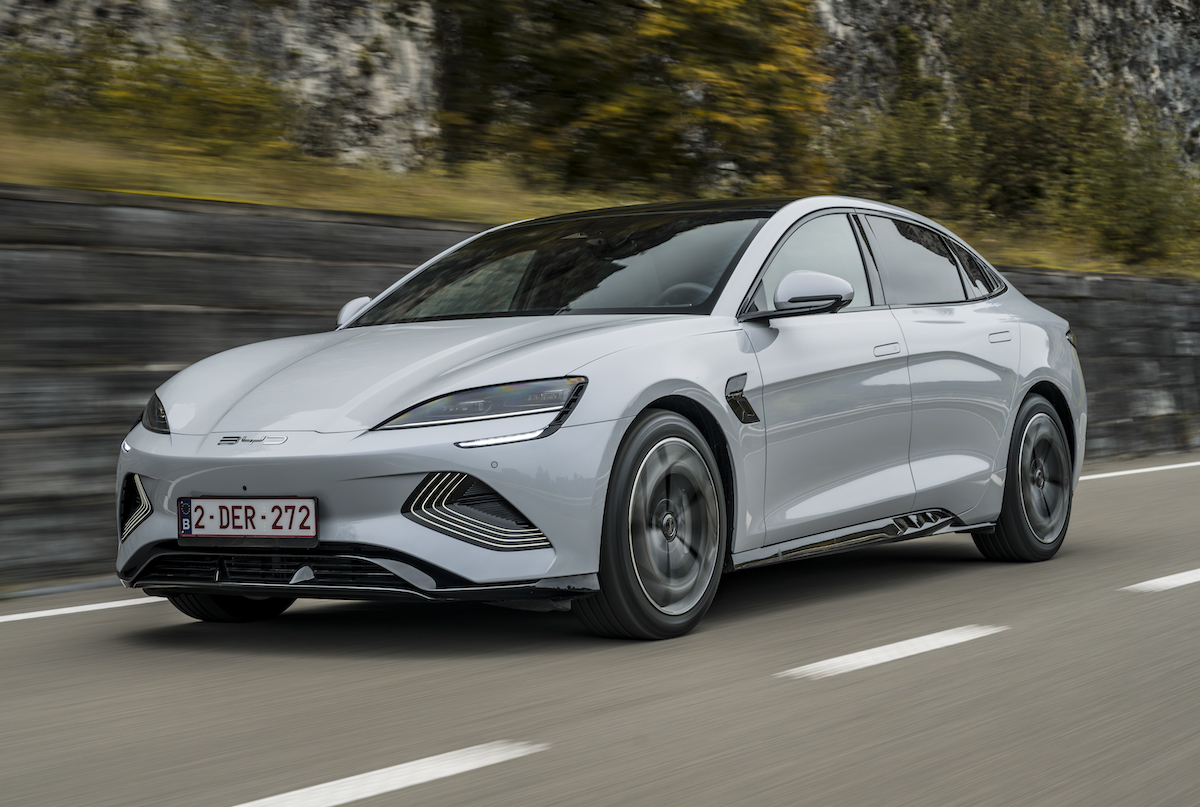
The new Seal is an electric, mid-sized saloon that is priced similarly to the Tesla Model 3, although at 4.8 metres the BYD is a fraction longer (it actually splits the difference between the Model 3 and the Hyundai Ioniq 6). It’s a handsome car to our eyes, with bold detailing at either end and a low-slung roofline that gives it an air of scaled-down Porsche Taycan.
An 82.5kWh battery gives the Seal an official, WLTP-tested range of up to 354 miles. That’s if you go for the rear-wheel-drive, 308bhp, single-motor variant; BYD claims 323 miles for the 523bhp dual-motor model. It also gets the BYD ‘Blade’ battery pack. These lithium-iron phosphate (LFP) cells use cobalt-free chemistry, saving resources of critical rare earth metals. The Blade battery is also said to be very safe; the company hammered a nail through one at a global press conference to demonstrate that it won’t catch fire when pierced in this way.
With generous equipment and prices starting from less than £46,000 (£49,000 for the AWD model), plus warranty cover for six years or 93,750 miles, it’s not hard to see why the Seal could tempt new car buyers away from the ubiquitous Tesla Model 3.

Practicality
How practical is it?
By the standards of compact saloons, the Seal’s practicality isn’t bad at all. There’s more rear legroom than you’ll find in a Tesla Model 3, plus you get a centre armrest and rear-seat charging ports for smartphones or other devices. The standard-fit panoramic roof makes it feel really light and airy without eating too much into headroom. Even taller adults will be reasonably comfortable in the back for a long journey.
A 400-litre boot is on par with the Hyundai Ioniq 6, if a little short of the Model 3’s 425 litres. In practice, however, we’d say the BYD is just as good for luggage space as its chief rivals. That’s because the boot space is deep and has a useful hidden underfloor storage compartment. There’s also a ‘frunk’ space beneath the bonnet of the car that is ideal to store the charging cables. The rival Polestar 2 is more practical still, mind. Its boot capacity is actually smaller, but the Polestar has a much wider and more practical hatchback opening, despite its saloon car styling.
If luggage space is a priority, you could consider hatchback or SUV alternatives. The Cupra Born and VW ID.3 are worth checking out, as are electric SUVs such as the Renault Scenic E-Tech and Kia EV3. Their bigger, top-hinged boot openings make life a lot easier if you have bulky items to lug about.
The Seal’s driving position is good, with a low-set seat and plenty of electric adjustment that makes it easy to get comfortable, even if visibility to the rear is a bit limited. The interior finish is great, with classy materials and a much more understated, European-style dashboard than you’ll find in the wacky BYD Atto 3. The pale grey-blue interior colour may be a bit too marine-inspired for some. If so, you can opt for a black finish instead.

Driving
What’s it like to drive?
The BYD Seal is surprisingly good fun to drive, whether you go for the entry-level, rear-wheel-drive Design model or the all-wheel-drive Excellence. With 0-62mph times of 5.9 and 3.8 seconds respectively, outright pace from the electric motors certainly isn’t an issue. The Seal also steers nicely, with fairly quick and predictable responses.
More than that, it turns keenly into corners and powers out nicely. This is courtesy of double wishbone suspension at the front and a multi-link setup at the rear, combined with variable shock absorbers on the more expensive all-wheel-drive car. Even the rear-driven model has good traction, though, and it feels secure in damp, greasy conditions. The moral of the story? Don’t feel that you need all-wheel drive just to cope with the British weather.
Where the Seal does fall a bit short is its pedal responses. Brake performance is OK, but you have to get used to the slightly inconsistent feel and long travel of the pedal. It can feel like not much braking is happening initially, then it will suddenly bite a bit more sharply than you intended. Throttle response is a touch sharp at times, too.
There are two brake recuperation modes in the Seal, but neither is the sort of one-pedal mode you get in a Nissan Leaf (the latter lets you drive around at lower speeds without touching the brake pedal at all).
The Seal delivers pillowy ride comfort over undulations and bigger bumps, making for an easygoing long-distance companion. It does thump over sharp-edged potholes, however, and coarse surfaces can send some vibrations through the steering wheel. So while refinement is good, it’s not quite up there with the Hyundai Ioniq 6.
While the Seal is fun and very well sorted, we’d still say the Kia EV6, Polestar 2 (on its optional performance dampers) or a used Jaguar I-Pace (which you can source easily at these prices) have the edge if you want an electric car that’s enjoyable to drive. Book yourself a test drive in each car to see which one you prefer.

Tech and equipment
Technology, equipment & infotainment
BYD doesn’t skimp on technology and equipment; most of the features on the Seal come as standard. Indeed, rather like Tesla, there aren’t any options beyond which colour paint and interior you would like. For the former, there are five choices in total, four of which will cost you an additional £1,100.
Standard kit includes a panoramic glass roof, head-up display, heated and ventilated electrically-adjustable seats, heated steering wheel, 12-speaker sound system, leatherette upholstery, keyless entry and 360-degree parking camera. The Seal really is generously equipped in both specifications, especially as BYD throws in its semi-autonomous drive mode with lane-change assist.
You also get a heat pump for boosting efficiency in cold weather, plus vehicle-to-load charging, which lets you power or charge any electrical device (e.g. a portable camping fridge) using the car’s high-voltage battery.
If this were an equipment-only section, we’d give the Seal a solid five stars, which applies to both the rear-wheel-drive Design and the Excellence AWD.
Sadly, there are some frustrations with the 15.6-inch infotainment touchscreen. It’s not a bad interface, and has a good navigation system with an EV charger search function, plus Apple CarPlay and Android Auto connectivity. It’s occasionally a bit laggy to use, though, and while the screen rotates to be either in portrait or landscape format, this ultimately feels like a bit of a gimmick. We found it better to just leave the screen in landscape mode so it doesn’t intrude your forward view out of the car.
More annoying is that the screen’s menu layouts make it hard to access certain functions. You have to swipe up to get climate control, then heated seats controls are another tap or two beyond that. Once you’re there, the menu takes up the whole screen, and requires a few taps to get back to your navigation, CarPlay or whatever else you were using before. It’s a bit haphazard in the way the menus are arranged, and the voice control isn’t great, either; you’ll have much more luck getting a Tesla, Hyundai or Polestar to understand you. No doubt these things will improve in time, as more Seal customers provide feedback, but for now they remain frustrating details.
The BYD Seal scored five stars in Euro NCAP crash tests. It achieved an 89 percent rating for adult occupant protection and an 87 percent score for child occupant protection.

Running costs
BYD Seal running costs
The Seal is competitively priced, especially given its generous equipment. The Design model will set you back £45,730, while the Excellence is priced at £48,730. Monthly PCP finance costs have also improved since the Seal was first launched in the UK, with lower or comparable monthly payments to similar cars such as the Kia EV3 or Tesla Model 3.
A full charge in the BYD Seal will cost roughly £25 if you’re paying 0.25p per kWh for your home electricity, or you can cut that cost by more than half if you charge on a cheap overnight tariff. That makes the BYD usefully cheaper to run than efficient diesel alternatives, but remember that charging at public chargers is much more expensive. Most drivers only charge electric cars at public rapid chargers occasionally when on a longer journey. Use them a lot and it can make EVs more expensive to ‘fuel’ than a traditional petrol or diesel car.

BYD Seal reliability
It’s too early to discuss the BYD Seal’s reliability, as this vehicle is still fairly new. However, its Blade battery technology has been around for a while and has been just as extensively tested as any electric car battery. BYD even states that it’s designed to last for 30 years, backing up its confidence with an eight-year, 125,000-mile battery warranty. The rest of the vehicle is covered for six years or 93,750 miles.
In January 2026, BYD UK announced a partnership with a business called QBE Automotive Protection. This allows BYD to offer extended warranties, along with additional service and maintenance plans. The Blade battery, for example, can be covered under warranty for up to 250,000km (155,000 miles), rather than the original 150,000km.


What owners say
Three things to know
- Real-world range in the BYD is good. We saw 300 miles per full charge in the AWD car, despite very cold conditions, so you may well get close to the 323-mile claimed range in the summer. Expect that figure to drop to around 270 miles for a winter run on the motorway, mind. The more efficient, single-motor Seal should do a touch better, so reckon on more like 280-340 miles in real-world use (versus 354 miles in the official test).
- The BYD Seal can charge at up to 150kW, which is on a par with rivals from Volkswagen, if not as fast as the Tesla Model 3 or Kia EV6. It’s still good for a 20-80 percent charge in around 20 minutes. Plug into your 7kW home wallbox and you’ll have a full charge from nearly empty in around 13 hours.
- The Seal’s LED headlights are not the fully adaptive ‘Matrix’ lights that most rivals offer (albeit often optionally). Instead, the BYD gets automatic high beam headlights, which simply switch the lights onto high or low beam, depending on whether the car senses other vehicles. It’s not a great system, and it’s rather prone to dazzling other road users, so we found it much more relaxing to just turn it off (again, quite a few layers into the screen menus, but it can be done) and have full control of the bright LED lights.
Which one to buy
- If you want the best value: Go for the BYD Seal Design. It’s good to drive, and a decent price for all the equipment and performance on offer.
- If you want the best company car: We’d stick with the Seal Design, as the rapid Excellence version will cost you more at current company car tax rates. The Design model is more than fast enough for UK roads, and the equipment on both cars is almost identical.
- If you want the best high-mileage commuter: Again, stick with the Design model, as it achieves a longer potential range of 354 miles.
- If you want the best family car: Guess what? We’d still go for the Design, tempting though it might be to upgrade to the Excellence for its additional performance. That said, if you’re buying via PCP finance, you’ll find the Excellence AWD isn’t much more in terms of monthly payments. If you’re a keen driver, or are concerned about icy and wintery conditions, then it could be worth making the small jump up to the all-wheel-drive Seal.


Pricing trends
Starting RRP
£44,990
Current avg. market price
£31,783
Trending up by 13.1% this month
May 2026 - October 2026