Volkswagen Golf 2026 review | Family hatch icon boosted by some well-judged updates
Volkswagen Golf cars for sale
4.0
Expert review
Pros
Desirable image
Great to drive
Comfortable ride
Cons
Fiddly infotainment system
Rivals offer more interior space
Not significantly better than a Mk7 Golf
The CarGurus verdict
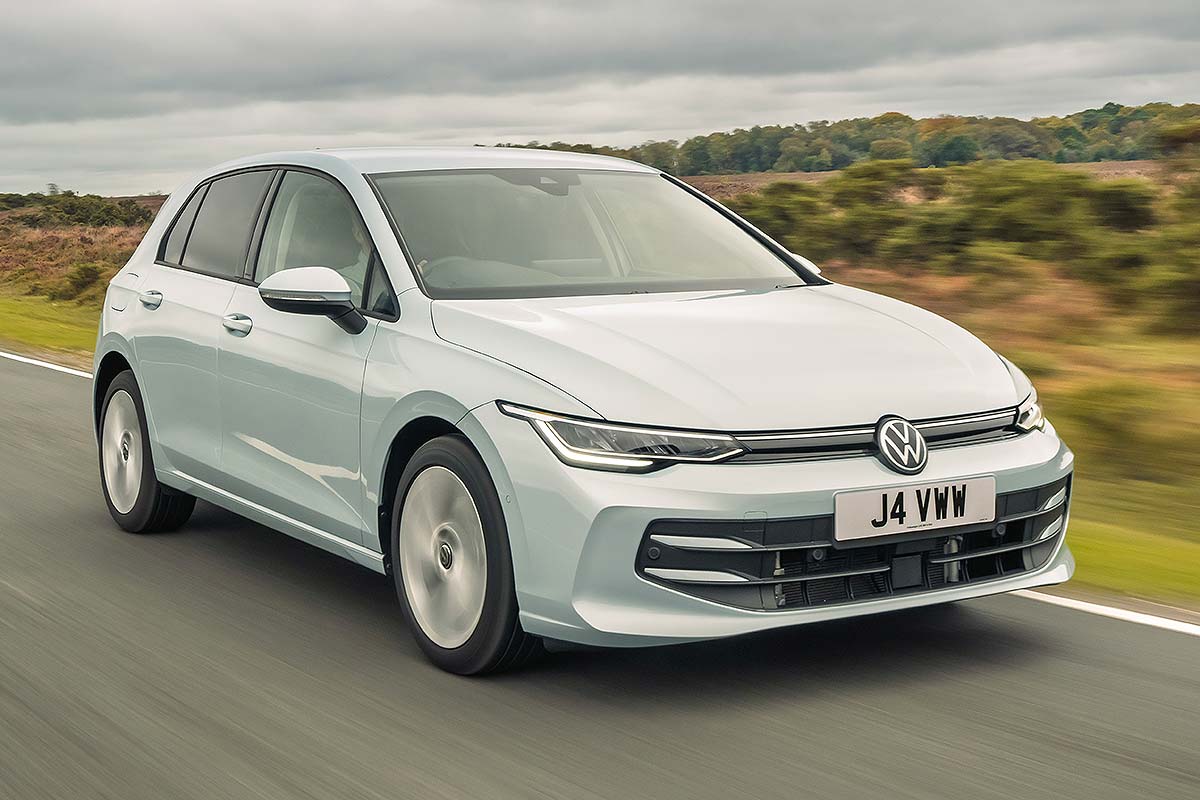
The Volkswagen Golf continues to be a safe choice in the family hatchback sector. Despite plentiful talk of this being the ‘digital Golf’ at launch, the Mk8 doesn’t do much, if anything, that the brilliant Mk7 didn’t. But then, as that car wasn’t really broke, Volkswagen didn’t really need to fix it – and arguably, some of the fancy interior tech it did add in to spice things up proved to be better in theory rather than practice; luckily, the 2024 facelift has fixed most of that…
Perfectly spacious, easy to drive, increasingly fuel efficient and, in sporty guise, a real thrill to drive, when all’s said and done, the Golf is still one of the best family hatchbacks you can buy. And while some rivals may be closer than they were, the demise of some others means the Golf remains the obvious choice in this sector. You still won’t go far wrong with one.

What is the VW Golf Mk8?
The Volkswagen Golf is one of the most popular family cars in Britain. This Mk8 version was introduced in 2020 as a sharper, sleeker evolution of the well-liked Golf Mk7. The styling was familiar while the interior received a full digital makeover. You can have the Golf as a five-door hatchback or estate, but the old three-door model has been dropped from the line-up. These days, few people want a three-door family hatch, anyway.
At launch, a pair of 10-inch digital displays (which came as standard to all new Golfs in the UK) took centre stage in a minimalist dashboard layout. There were precious few physical buttons, with ventilation controls either buried within the central touchscreen or relocated to a trio of (awkward) touch-sensitive sliders just beneath it. These weren’t even illuminated at night. Add in a confusing touchscreen layout, and well-justified criticism followed.
With the Volkswagen Golf’s 2024 facelift, the firm responded. As standard, it offered a larger 12.9-inch touchscreen which, crucially, introduced all-new infotainment software. This is far more straightforward to use, and helped overcome many of the Volkswagen Golf Mk8’s early ills. And while physical climate control buttons and dials didn’t make a comeback, Volkswagen did illuminate the touch-sensitive controls – and ditch the dreadful touch-sensitive steering wheel controls for proper buttons.
The core range of Life, Style and R-Line models is further enhanced by the value-packed Match edition, one of the more popular Golf models in the UK. There’s a broad choice of petrol, diesel, mild hybrid and plug-in hybrid engines, with both manual and automatic gearboxes available – indeed, the choice is perhaps too broad in places – and, of course, then there’s the acclaimed GTI and R high-performance range-toppers.
A previous range of Volkswagen Golf bodystyles have coalesced into the core five-door hatchback today – yes, even the estate has been withdrawn in 2026. There’s complexity elsewhere in the range, but at least choosing the right bodystyle is simple. Saying that, Volkswagen doesn’t yet offer an electric Golf either, unlike some rivals. We’ll have to wait for the next-generation model before a fully plug-in Golf arrives.
The Volkswagen Golf’s rivals include stalwarts such as the Vauxhall Astra and Peugeot 308, the newer Kia K4, Honda Civic, Toyota Corolla, Mazda 3, the Seat Leon / Cupra Leon duo and the extra-roomy Skoda Octavia. Fancy a premium alternative? Try an Audi A3, BMW 1 Series or Mercedes-Benz A-Class. One obvious fierce new car rival is no more though, following Ford’s baffling decision to stop production of the Focus. How many blue oval customers have since made the switch to VW, we wonder?

How practical is it?
There’s plenty of room inside the Volkswagen Golf for four adults to sit comfortably. Build and material quality are good too, albeit no longer outstanding for the class. Being a hatchback rather than a crossover means you don’t get the elevated driving position that some people like, either, but that aside the Golf offers plenty of comfort as well as storage space for odds and ends. Headroom and legroom in the back of the car are good for the class, albeit not as generous as in the Skoda Octavia. But then, few cars in this sector are.
Volkswagen has really thought about the small details in the Golf. The door openings don’t get in the way when you’re jumping in and out, for example, and the door stays help you when getting in and out in tight spaces. All the controls are well-placed, the door bins are usefully large and all-round visibility is excellent. It’s an easy, unintimidating car to drive. Facelifted models also saw proper steering wheel buttons return, rather than the previous touch-sensitive controls; they’re far more practical to use (although they do remain in Golf R models, due to that version’s bespoke steering wheel ‘R’ button).
Regular TSI and eTSI Volkswagen Golf have a practical 381-litre boot. Fold the rear seats flat and this expands to almost 1,300 litres. Naturally, the shape is very well-designed, with a clean and practical layout. However, due to the space taken up by their plug-in hybrid batteries, eHybrid and GTE models do see a reduced boot capacity of 273 litres, which is smaller than many superminis. You’ll notice the space isn’t as deep, although this does make it a bit easier to load.
Although it’s strictly now a used car choice, the Volkswagen Golf Estate offers buyers useful added practicality thanks to a boot that expands from 381 litres in the hatchback to a commodious 611 litres. Again though, the plug-in hybrid versions have less space.
Another small point is that the Volkswagen Golf Mk8 hatch does not offer an electric ‘hands-free’ tailgate. Only the Golf Estate was available with an electric bootlid. Oh, and the Volkswagen Golf is available with a space-saver spare wheel; it's a £315 option.
What's it like to drive?
The Volkswagen Golf offers a core range of TSI petrol engines. The 1.5-litre motor is available in 113bhp or 148bhp guise, both offering easygoing pulling power and decent acceleration. A six-speed manual gearbox is standard, with DSG automatics also available. There’s also an eTSI mild hybrid, whose tiny electric motor and battery takes the load off the engine when accelerating, and helps extend the engine stop-start functionality, to save a bit of fuel in real-world driving.
Although there’s no electric Golf, Volkswagen does offer plug-in hybrid versions, with the regular range called eHybrid and the performance version carrying GTE branding. They all now have a much larger 19.7kWh battery, which gives a really useful EV range of up to 88 miles. They have DC rapid charging functionality too, so can top up at a 50kW public charger in under half an hour. Due to the quirks of how plug-in hybrid fuel economy is tested, they can officially average over 200mpg; the reality is that you’ll use little fuel if you regularly charge the battery when it gets low, and see efficiency similar to one of the other TSI engines if you don’t.
After many decades, Volkswagen has taken the decision to pull diesel Golfs from the UK. The TDI and GTD versions were once a staple of the range, but in recent years, sales have slowed to a trickle. There’s simply no demand for a new Golf diesel here in the UK, with the fuel-sipping eTSI and eHybrid versions taking over the mantel for those who want to save at the pumps. The Volkswagen Golf Mk8 line-up also includes the high-performance GTI and R models. They all use a 2.0-litre four-cylinder turbo petrol engine, with even the entry-level Volkswagen Golf GTI having a heady 261bhp these days. The GTI Clubsport has even more, while the Golf R now packs a huge 328bhp punch.
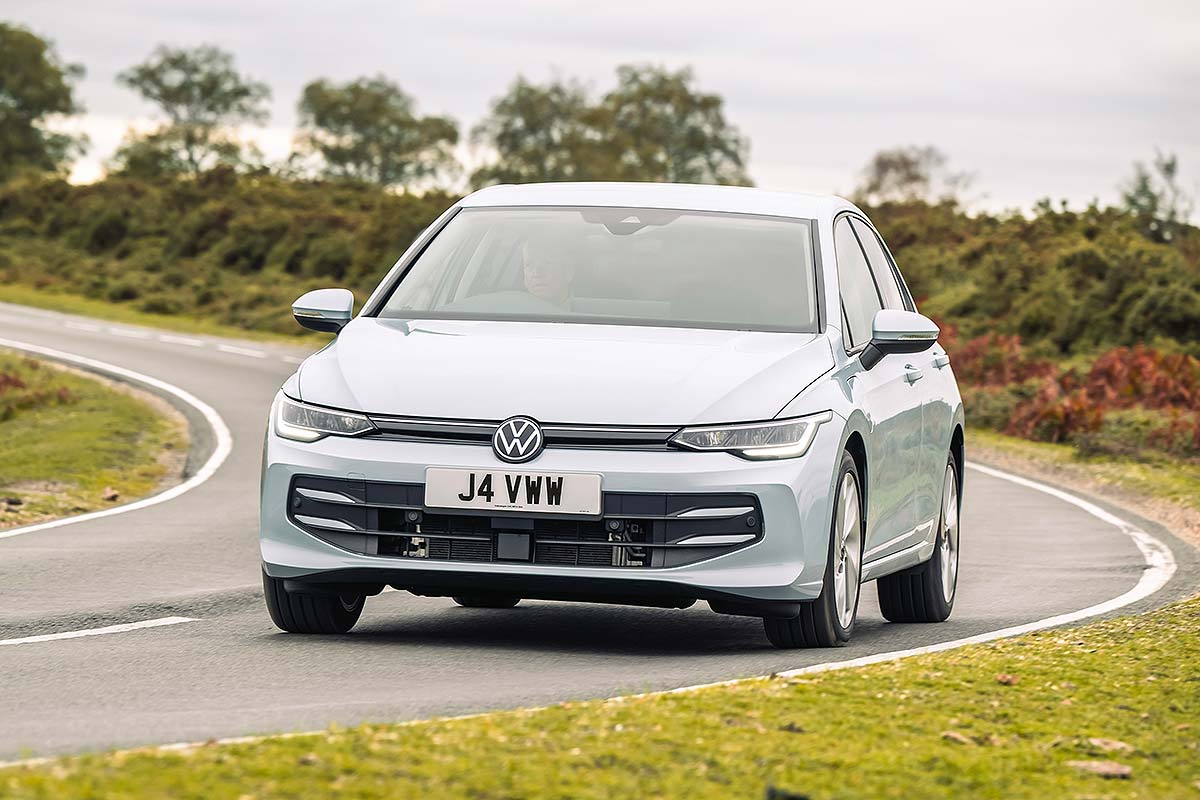
In terms of the way the Volkswagen Golf drives, there are no nasty surprises with this Mk8 version. It’s safe, solid and sensible – with a clear focus on comfort and refinement. There’s a sense of refined composure that gives it a bit of a premium feel, and its viceless dynamics generally handle anything that Britain’s roads can throw at it. Just note that the ride gets a bit firmer – and high-speed tyre noise can increase – on models such as R-Line versions with larger alloy wheels.
Saying that, the GTI and R models do have a much sportier edge, particularly in facelifted guise. They now have a central dynamic computer, that masterminds everything to do with how they drive – some versions have DCC dynamic suspension control that enhances this yet further. In a nutshell, the GTI is pin-point sharp and engaging, with a characterful front-wheel-drive feel, while the all-wheel drive R, using the famed 4Motion system, is a bit more grown-up and effortless, albeit still thrilling.
The standard GTI is a great all-rounder with more than enough power; Clubsport enhances the crispness yet further, and the power-packed R has the effervescence that you feel could almost challenge a Porsche at times. All of them are high-performance hatchbacks at the very top of their game.

Technology, equipment & infotainment
For the Mk8 Golf, Volkswagen focused much of its effort on a new suite of connected technologies and driver assistance systems. Arguably, the tech launched a bit too soon, so a comprehensive overhaul with the 2024 facelift was welcome. The Golf is still a ‘digital-first’ car, but the updated (and larger) infotainment touchscreen is far easier to use, with a clearer, more colourful display and handy shortcut menus along the bottom and top of the screen.
The Volkswagen Golf even incorporates ChatGPT. This is built into the IDA voice assistant. Drivers either press a button on the steering wheel or say ‘hello IDA’ to control aspects such as sat nav and climate control via voice. It is able to maintain context even with more complex commands, and the AI database behind it is said to be constantly improving.
Among the driver assistance systems are familiar programmes such as lane keep assist. That particular system has its uses, but many drivers will find themselves habitually switching it off at the start of each journey. There’s also traffic sign recognition, an automatic speed warning (which can also be switched off), adaptive cruise control, and forward hazard detection.
One clever piece of tech is called Car2X, which enables the new Golf to communicate with local traffic and roadside infrastructure to warn the driver of hazards in the road ahead, traffic jams and even approaching emergency vehicles. The functionality of this will continue to develop thanks to Volkswagen’s ‘over-the-air’ software updates.
All Volkswagen Golf apart from base Life have a rear-view camera, which makes reversing much easier, plus keyless access and adaptive cruise control. It’s worth noting that every version, even the base model, gets Climatronic automatic climate control, for all-year-round comfort whatever the temperature outside. This also means you don't need to use the fiddly slider controls as much, too...
The Volkswagen Golf R-Line is a popular trim in the UK. This apes the sporty look of the Golf R range-topper, with diamond-cut black alloy wheels, gloss black exterior trim details, lower-slung sports suspension and premium sports seats with R-Line upholstery. In eTSI guise, it’s a great all-rounder, and one that still returns over 54mpg despite its sporty appearance.

Volkswagen Golf Mk8 running costs
Volkswagen Golf Mk8 fuel economy is generally strong across the range. Even a standard 1.5 TSI engine will return over 50mpg, with eTSI models pushing this to over 55mpg. These are official figures, so real-world driving may differ, but experience tells us the Golf can be surprisingly fuel-efficient in everyday motoring too. There’s also little difference between manual and DSG automatic models in terms of fuel economy, either.
As for performance models, even the basic GTI nudges 40mpg in official testing, although the potent Volkswagen Golf R does dip to below 35mpg, not helped by its 4Motion all-wheel drive system. If you really want a sporty Golf with the potential for excellent fuel economy, choose the GTE plug-in hybrid.
As mentioned, the Volkswagen Golf eHybrid versions, with their extended EV range of up to 88 miles, will give remarkable mpg if you charge up a few times a week, and more conventional figures if you don’t. If you buy one, it might be worth investing in a home charger and getting into the habit of plugging it in each night to maximise your EV running.
Volkswagen offers fixed-price servicing on its cars and it also gives you the option of spreading the cost over a number of years. A minor service should be carried out every 12 months or 10,000 miles, costing around £200. Meanwhile, a major service will set you back in the region of £375-£400. You’ll need one of those every 24 months or 20,000 miles.
A brand new car shouldn’t need any unscheduled remedial work during the first couple of years of its life, but as the vehicle ages, the odd job might need to be carried out to fix faults or replace worn out components. For a new set of front brake pads, for instance, a Volkswagen dealership will charge around £200. For front pads and discs, you’ll pay around £350.

Volkswagen Golf Mk8 reliability
Volkswagen offers a three-year manufacturer warranty. For the first two years there’s no mileage limit. The warranty then expires after the end of the third year or once 60,000 miles have passed, if that happens sooner. However, certain manufacturers such as Hyundai and Kia underwrite their cars for five or even seven years – and other brands such as Toyota are even offering 10-year service-activated warranties, that offer cover so long as you have an annual service at an official dealer. Volkswagen Golf drivers can extend their warranties too, but it will cost around £150 year.
According to the latest What Car? reliability survey, Volkswagen is the sixth most unreliable car brand in the UK. This seems to be due to problems from electric models such as the ID3 and ID4 though, with core cars like the Golf performing better. You shouldn’t expect the peerless dependability you get from some Japanese cars, but the Golf still shouldn’t throw up any major surprises on the reliability front.
Related to that is the Golf’s excellent safety certification – like the previous one, this latest model was awarded the full five stars by Euro NCAP, thanks in part to its six airbags as standard and suite of driver assistance systems. This rating applies to the very latest facelifted version too, as Euro NCAP retested it in 2025, awarding 80% for adult occupant and 86% for child occupant protection.
- The most basic versions of the VW Golf use front-wheel drive and a simple and cheap torsion beam rear suspension arrangement. Meanwhile, higher-spec models feature a more sophisticated multi-link rear end. For some people that won’t matter one bit, but keener drivers will appreciate the improved ride quality the multi-link arrangement confers. As a general rule of thumb, models with 150PS (148bhp) and more have the better multi-link rear suspension.
- In the UK, entry-level Golfs are badged Life, and only come with a limited engine choice. Next up is the great-value Match grade, offering plenty of value for money and the most comprehensive choice of engines. Then comes Style, which is a bit posher, and the sportier-looking R-Line. Volkswagen also offers a smart-looking Black Edition Golf – and all models have a broad range of options, too.
- The sporty Volkswagen Golf GTE, GTI, GTI Clubsport and R models are among the most enjoyable hatchbacks and hot hatchbacks on the market, with strong performance and excellent handling. For 2026, there’s also a special edition GTI Edition 50, marking 50 years of the Golf GTI; it’s a sure-fire collectable. Note, Volkswagen no longer offers the diesel-engined Golf GTD.
- If you’re on a strict budget: the cheapest, most basic Golf is a Life model with the 113bhp 1.0-litre petrol engine… but we’d strongly recommend spending just a few hundred pounds more to get a Golf Match with the same engine.
- If you want to save at the pumps: an eHybrid, now with its extended-range battery, is a good choice. It allows plenty of everyday motoring in full electric guise, and is pretty efficient when the batteries are flat, too.
- If you want best value for money: the Golf Match is the most eagerly-priced version, once you factor in its generous equipment. And the best-value engine is the eTSI, thanks to its fuel-saving tech and standard DSG automatic gearbox.
- If you’re a petrolhead at heart: the GTI is a thrilling hot hatch while also being perfectly usable day-to-day; if you want it even rawer and more potent, choose a GTI Clubsport or Edition 50. The even more powerful four-wheel-drive Golf R variant is even faster still, with the kind of performance that'll leave you breathless, along with all-wheel drive traction to help you make the most of it.


